
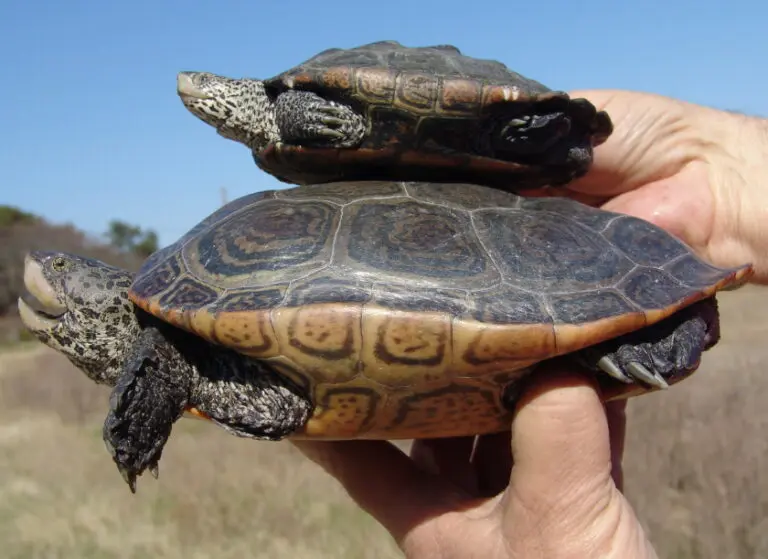
Crab traps do not kill terrapins at random.
In 2007, John Willson, Whit Gibbons, and I used 21 years of mark–recapture data from Kiawah Island to examine why a diamondback terrapin population was declining. The answer was visible not only in how many turtles remained, but in which turtles were missing.
Terrapins are strongly sexually dimorphic. Adult males are much smaller than adult females, and males and young females can enter most blue-crab pots. Large adult females often outgrow the openings. A terrapin entering a submerged pot may be unable to escape before drowning.
At Kiawah, crab-pot mortality was size- and sex-selective. Males and younger females remained vulnerable, while the largest females gained some protection from size alone. Over two decades, the population became older, larger, and more female-biased, with fewer young animals—exactly the pattern expected when smaller terrapins are removed disproportionately.
In 2009, Andrew Grosse and colleagues documented 133 terrapin carcasses in abandoned crab pots in one Georgia tidal marsh—more than twice the estimated surviving population there. Andrew then led a broader 2011 study showing that greater crabbing pressure was associated with lower terrapin abundance and fewer young or small individuals.
Research elsewhere found similar effects, although the details varied with local body sizes and trap openings. Even adult females can be vulnerable where they are small enough to enter.
Fishing gear can therefore remove particular sizes, ages, or sexes rather than a random sample of the population. Counting dead animals alone may underestimate the impact. Selective mortality can alter age structure, sex ratio, recruitment, and the body-size distribution of survivors long before a population disappears.
Understanding the mechanism also points toward solutions.
Later work with Rebecca McKee and Kristen Cecala examined terrapin interactions with crab pots in controlled laboratory trials. With the equipment tested, BRDs reduced entrapment, delayed entry, and lowered successful entries relative to investigations. Vertically oriented BRDs were more effective than horizontal ones. Terrapins also investigated fish-baited pots more often than chicken-baited pots. These findings show how installation and bait choice can influence risk, while recognizing that performance can vary with device design, terrapin size, and field conditions.
Conservation is not always about stopping human use. Sometimes small changes in fishing gear or practices can reduce predictable mortality while allowing a fishery to continue.
A marsh may still contain terrapins while losing the age and sex classes needed to sustain the population.
Presence is not the same as population health.
Selected references:
Grosse et al. 2009. Diamondback terrapin mortality in crab pots in a Georgia tidal marsh. Chelonian Conservation and Biology 8:98–100. https://doi.org/10.2744/CCB-0729.1
Dorcas, M. E., J. D. Willson, and J. W. Gibbons. 2007. Crab trapping causes population decline and demographic changes in diamondback terrapins over two decades. Biological Conservation 137:334–340. https://doi.org/10.1016/j.biocon.2007.02.014
Grosse et al. 2011. Effects of roads and crabbing pressures on diamondback terrapin populations in coastal Georgia. Journal of Wildlife Management 75:762–770. https://doi.org/10.1002/jwmg.104
McKee, R. K., K. K. Cecala, and M. E. Dorcas. 2016. Behavioural interactions of diamondback terrapins with crab pots demonstrate that bycatch reduction devices reduce entrapment. Aquatic Conservation: Marine and Freshwater Ecosystems 26:1081–1089. https://doi.org/10.1002/aqc.2587
This Insight is part of my ongoing LinkedIn series on reptiles, amphibians, conservation biology, invasive species, and scientific writing. Follow Michael E. Dorcas on LinkedIn for new posts and discussion.