
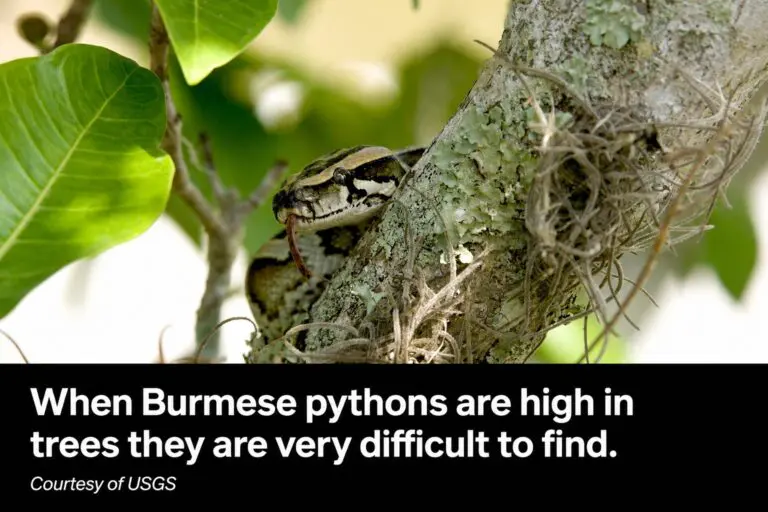
How many Burmese pythons are in Florida?
That seems like a simple question. It is not.
A recent synthesis led by Jacquelyn Guzy and colleagues makes this point clearly: despite decades of python removals and research, there are still no reliable estimates of Burmese python abundance or density across southern Florida.
Not because people have not been trying. Pythons are extraordinarily difficult animals to count.
Most wildlife population estimates depend on detecting animals: seeing them, capturing them, marking and recapturing them, photographing them, or documenting their DNA.
With Burmese pythons, that first step is the main problem.
They are cryptically colored and spend much of their time hidden in vegetation, under cover, underground, or in water. Much of the Greater Everglades is vast, remote, flooded, densely vegetated, and difficult to access. Even large pythons can be missed at close range.
Detectability is not just low. It also varies over time.
A python is more likely to be found when active, moving, crossing a road or levee, basking, or otherwise exposed. It is much less likely to be found when inactive, submerged, underground, under cover, concealed in dense vegetation, or high in a tree.
So the same search effort can produce different results depending on activity, season, weather, habitat, and observer experience.
That means the number of pythons removed is not the same thing as the number of pythons present.
Removal data are useful. They tell us where snakes have been found and provide information about size, sex, diet, reproduction, genetics, contaminants, parasites, movement, and other aspects of python biology.
But raw removal numbers are not population estimates.
If more pythons are removed in one year than another, that could mean the population increased.
Or it could mean more search effort, better access, more paid contractors, more experienced searchers, better weather, more road and levee searching, or snakes were simply more active and detectable.
The reverse is also true. If fewer pythons are found, that does not necessarily mean the population declined. It may simply mean fewer snakes were active, exposed, or detectable.
This is one reason python management is so difficult. To know whether a control program is working, we need a way to estimate population size or even track a reliable index of relative abundance over time.
But when individual detection probability is extremely low and variable, even that becomes a major scientific and logistical challenge.
So when you hear numbers thrown around about how many Burmese pythons are in Florida, be cautious. Some estimates may sound precise, but precision is not the same as accuracy.
The honest answer is: we do not know how many pythons are in South Florida. And that uncertainty is one of the central challenges of managing the invasion.
Reference:
Guzy et al. 2023. Burmese pythons in Florida. NeoBiota 80: 1–119.
This Insight is part of my ongoing LinkedIn series on reptiles, amphibians, conservation biology, invasive species, and scientific writing. Follow Michael E. Dorcas on LinkedIn for new posts and discussion.