
Could a wild Burmese python kill a person in Florida?
Yes.
Large constrictors are physically capable of killing humans, and fatalities involving both wild and captive pythons have occurred. Whether a snake could swallow a particular person is a separate question. A sufficiently large python could kill by constriction without being able to consume the body.
No human death has been attributed to a wild Burmese python in Florida. But several apparently unprovoked strikes by large pythons have been documented in the Everglades. These incidents were probably predatory responses—snakes striking at what they perceived as potential prey—rather than defensive bites. None resulted in constriction or serious injury.
So the probability of a wild python killing someone in Florida appears extremely low.
But it is not zero.
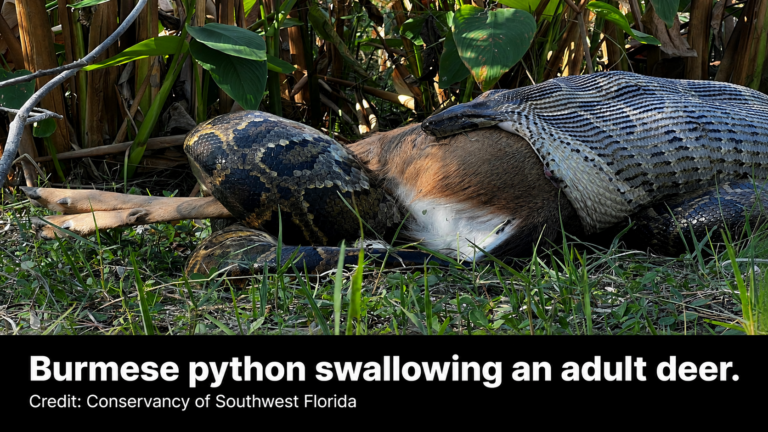
The prey-size issue also deserves a little more attention than it used to receive. Burmese pythons in Florida have now been documented consuming very large prey, including white-tailed deer. In one recent case, researchers observed a nearly 15-foot, 115-pound Burmese python swallowing a 77-pound deer.
That does not mean a wild python is likely to attack and swallow a child.
It does mean we should not dismiss the possibility simply because a child seems too large to be swallowed. Very large Burmese pythons are capable of consuming prey in that size range.
Pythons occur along canals, around houses, and in other places used by people. I do not like to imagine it, but I can envision a large snake grabbing a child fishing beside a canal. That has not been documented in Florida, but it is biologically plausible.
Still, for people working on the python issue in the Everglades, python attack is nowhere near the top of the safety concerns.
The real dangers of fieldwork are usually more ordinary: driving long distances to field sites, working in extreme heat, drowning, lightning, unstable footing, and severe allergic reactions to ants, bees, or wasps.
Years ago, one of my students was bitten by an ant; something we usually do not think twice about. She had never experienced a serious reaction before, but soon began swelling and having difficulty breathing. She was having an anaphylactic reaction.
Fortunately, my research coordinator was able to get her to an emergency room quickly, where she received epinephrine and steroids.
After that, I made sure our field trucks carried EpiPens.
The experience reinforced something that is easy to forget when thinking about field biology: the most dramatic hazard is not necessarily the most dangerous one.
Risk assessment is not about claiming that frightening events are impossible. It is about distinguishing what could happen from what is most likely to happen, and then preparing accordingly.
A large wild python could kill a person in Florida.
But during my years supervising field research, I worried far more about highways, heat, water, and the massive physiological response that can follow an encounter with a very small insect.
References:
Guzy et al. 2023. Burmese pythons in Florida: A synthesis of biology, impacts, and management tools. NeoBiota 80:1–119.
Reed, R. N., and R. W. Snow. 2014. Assessing risks to humans from invasive Burmese pythons in Everglades National Park, Florida, USA. Wildlife Society Bulletin 38:366–369.
Jayne, B. C., I. C. Easterling, and I. A. Bartoszek. 2024. Big pythons, big gape, and big prey. Reptiles & Amphibians 31(1):e21867. https://doi.org/10.17161/randa.v31i1.21867
This Insight is part of my ongoing LinkedIn series on reptiles, amphibians, conservation biology, invasive species, and scientific writing. Follow Michael E. Dorcas on LinkedIn for new posts and discussion.