
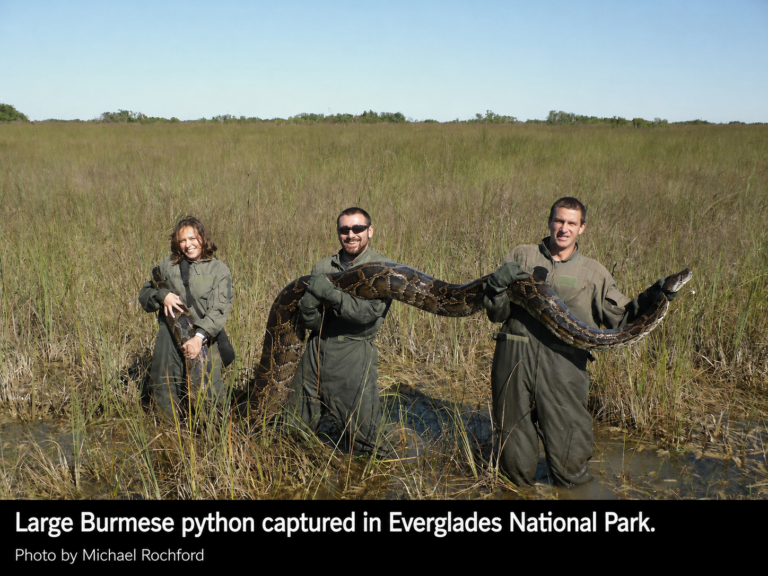
If you had told me 30 years ago that one of the largest snakes in the world would be thriving in the wild in the United States, I would not have believed you.
If you had told me 15 years ago about some of the impacts they would have, I would not have believed you either.
Not because I did not understand snakes. I’ve been around snakes all my life.
I would not have believed it because the scenario just seemed so far-fetched.
But I was wrong.
In retrospect, many of the traits that made Burmese pythons such effective invaders in Florida now seem much clearer.
They grow rapidly into large-bodied predators capable of consuming a wide range of prey.
They have high reproductive potential.
One recent study from southwestern Florida documented a wild female Burmese python that reproduced in six of seven breeding seasons. For a large constrictor capable of laying scores of eggs at a time, that represents an enormous potential contribution to population growth over time.
Female Burmese pythons coil around their eggs, providing protection and helping regulate incubation conditions. Brooding females can also generate heat through muscular contractions, often called shivering thermogenesis. Maternal care does not make a nest invulnerable, but it can help protect developing eggs.
As ectotherms, pythons require much less energy than similarly sized mammals and can tolerate long periods without feeding. Those traits can help them persist when prey is scarce. Their effects on population density depend on other factors as well, including habitat, prey availability, survival, and reproduction.
Yet they remain difficult to detect in dense wetland habitats.
Pythons are also generalists. Burmese pythons are not dependent on one prey species or one narrow habitat type. In Florida, that flexibility matters.
None of these traits alone explains the invasion or its impacts.
But together, they help explain why the species became such a formidable ecological problem once it was established.
That is one of the recurring lessons in invasion biology: the warning signs often look much clearer in hindsight than they do during the early stages of an invasion.
By the time the pattern becomes obvious, the biology of the invader may already be working strongly in its favor.
Reference: Easterling, I.C. & Bartoszek, I.A. 2025. Annual reproduction and reproductive frequency of Burmese Pythons (Python bivittatus) in southwestern Florida, USA. Reptiles & Amphibians 32:e23035. https://doi.org/10.17161/randa.v32i1.23035
This Insight is part of my ongoing LinkedIn series on reptiles, amphibians, conservation biology, invasive species, and scientific writing. Follow Michael E. Dorcas on LinkedIn for new posts and discussion.