
Introduced, established, and invasive species are not the same thing. An introduced species has been moved by humans outside its native range. An established species reproduces and maintains a population without continued introductions. In U.S. management usage, an invasive species is nonnative and causes, or is likely to cause, ecological, economic, or human-health harm. Scientific usage varies, so it helps to make clear which meaning we intend.
The United States has many introduced reptiles and amphibians. Some persist mostly around buildings, farms, nurseries, canals, roadsides, suburbs, ornamental plantings, and other human-altered landscapes. They may be interesting, locally abundant, and even have ecological effects. But they are not all equivalent.
A nonnative gecko living around porch lights is a very different management problem than a large predator established across much of southern Florida.
Burmese pythons are not just introduced. They are established. They are spreading. And they are invasive.
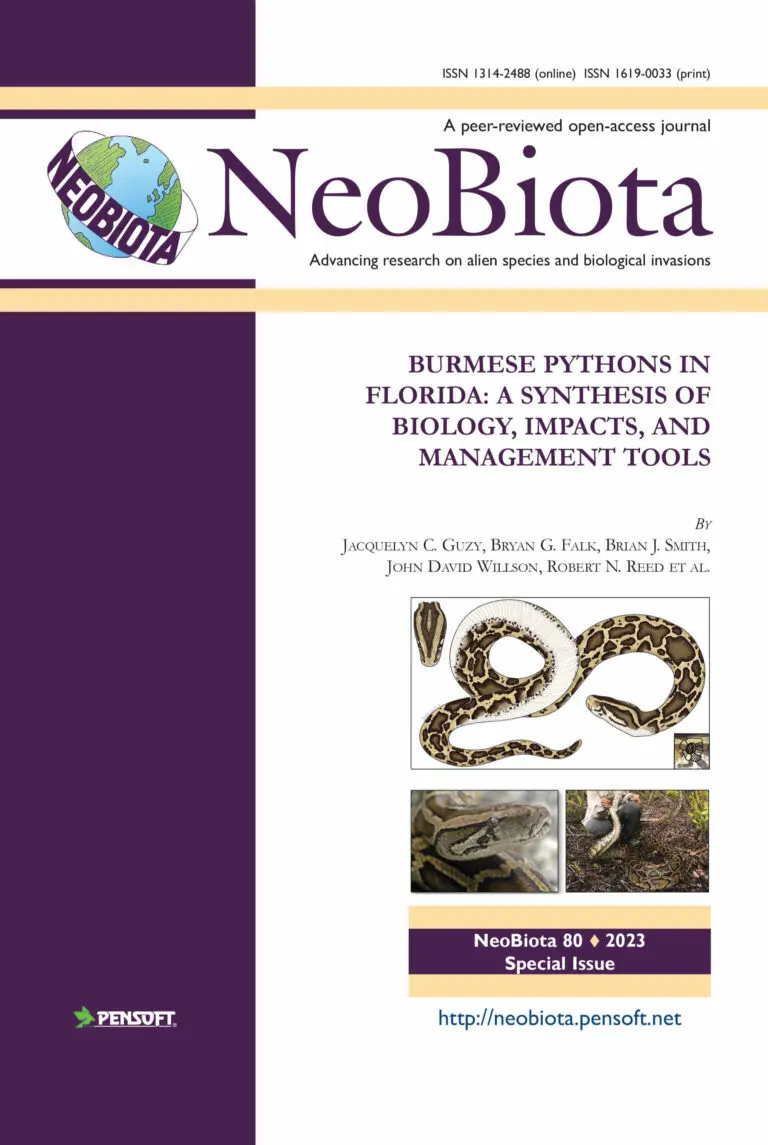
A recent synthesis led by Jacquelyn Guzy and colleagues makes this clear. Burmese pythons now occupy much of southern Florida, including the Greater Everglades Ecosystem. They occur in many natural and human-altered habitats and can travel long distances.
That habitat flexibility matters. Many introduced species do best in landscapes we have already modified: cities, farms, canals, disturbed edges, buildings, roadsides, and neighborhoods. Burmese pythons use those places too.
But they are not restricted to human-altered landscapes. They also occur in natural and semi-natural habitats, including marshes, mangroves, tree islands, hammocks, cypress areas, uplands, and other parts of South Florida. They tend to be associated with water, but are not limited to habitats most people would call “wetlands.”
That flexibility is one reason they are such a serious conservation problem and so difficult to manage.
If an introduced species is restricted to a nursery, warehouse district, neighborhood, or small disturbed area, early detection and rapid response may still be possible. If a species is reproducing across thousands of square kilometers of natural and human-altered habitat, much of it difficult to access, the challenge is completely different.
This is why language matters. Not every introduced species becomes invasive. Not every established species causes major harm. But when a species is introduced, established, widespread, cryptic, hard to detect, and capable of altering entire ecosystems, the problem changes dramatically.
That is where Burmese pythons are now.
They are not simply nonnative snakes in Florida. They are an invasive predator embedded across a large and complex South Florida landscape.
Reference:
Guzy et al. 2023. Burmese pythons in Florida: A synthesis of biology, impacts, and management tools. NeoBiota 80: 1–119. https://doi.org/10.3897/neobiota.80.90439
This Insight is part of my ongoing LinkedIn series on reptiles, amphibians, conservation biology, invasive species, and scientific writing. Follow Michael E. Dorcas on LinkedIn for new posts and discussion.