
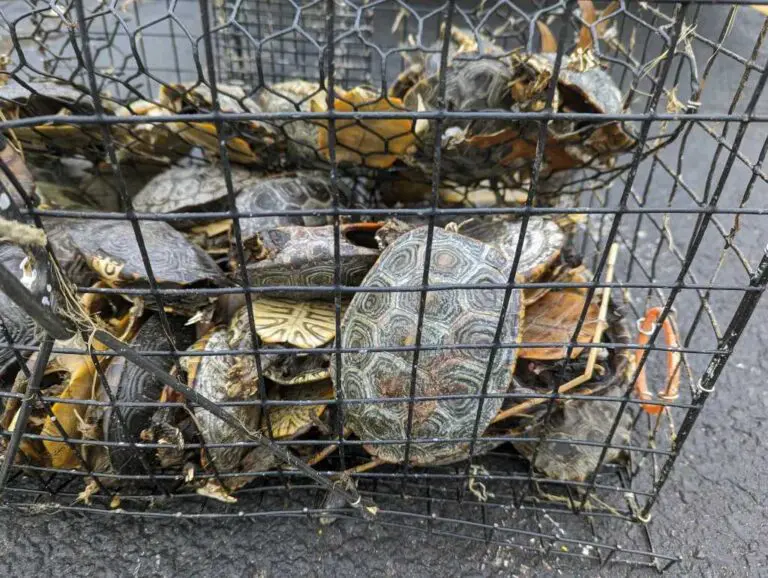
Why does the loss of a few adult diamondback terrapins matter so much?
The answer lies in their life history.
Diamondback terrapins lay eggs, sometimes in multiple clutches, but producing eggs is not the same as producing adult terrapins. In many turtle populations, nest and hatchling mortality are extremely high. For diamondback terrapins specifically, nest predation can be severe; in some places, raccoons alone have been reported to account for more than 90% of nest failures. Even if they hatch, most baby terrapins never reach adulthood.
Turtles evolved with this reality. Their populations are not sustained by high survival of eggs, hatchlings, or juveniles. They are sustained by the long lives of adults and by the survival of subadult turtles that are close to entering the breeding population.
This is why adult and subadult mortality can be so damaging to terrapin populations.
When a subadult or adult female terrapin drowns in an unattended crab pot, the population loses much more than one turtle. It loses years of future reproduction. And because terrapins mature slowly, and because so few young survive to adulthood, the population cannot quickly replace that loss.
Justin Congdon and colleagues made this point clearly in their demographic work on long-lived turtles: populations with delayed maturity and long adult lifespans are highly sensitive to even small increases in mortality of older individuals. In many turtle species, sustained harvest or other chronic sources of mortality are simply not biologically sustainable.
That is the life-history lesson behind crab-pot bycatch.
Protecting nests matters. Protecting hatchlings matters. But for long-lived turtles, the foundation of population stability is survival of adults and near-adults.
For diamondback terrapins, keeping subadults and adults alive may be the single most important conservation action we can take.
References
Congdon, J.D., Dunham, A.E., & van Loben Sels, R.C. 1993. Delayed sexual maturity and demographics of Blanding’s turtles: implications for conservation and management of long-lived organisms. Conservation Biology 7:826–833.
Munscher, E.C., et al. 2012. Decreased nest mortality for the Carolina diamondback terrapin following removal of raccoons from a nesting beach in northeastern Florida. Herpetological Conservation and Biology 7:176–184.
Photo: Maryland Dept. of Natural Resources
This Insight is part of my ongoing LinkedIn series on reptiles, amphibians, conservation biology, invasive species, and scientific writing. Follow Michael E. Dorcas on LinkedIn for new posts and discussion.