
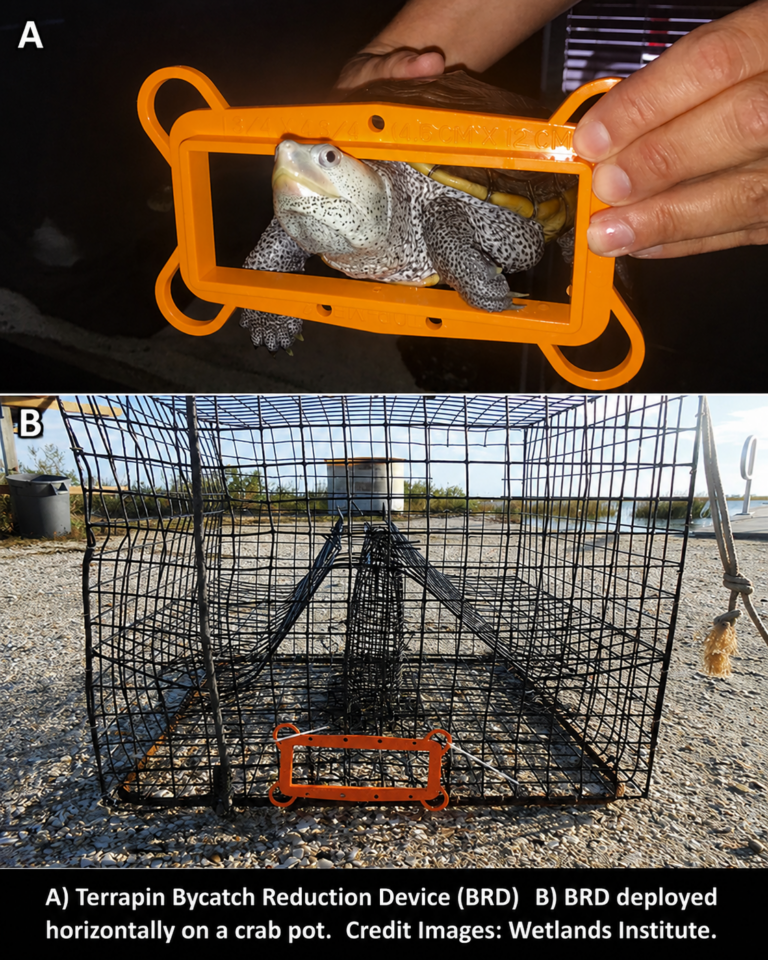
Most people who know about sea turtle conservation have heard of turtle excluder devices, or TEDs, in shrimp trawl nets. The basic idea is simple: modify fishing gear so the target fishery can continue while reducing sea turtle mortality. That same principle applies to diamondback terrapins and crab pots.
The devices are different, and the fisheries are different. TEDs in shrimp trawls are designed to let sea turtles escape from moving trawl nets. Terrapin bycatch-reduction devices, often called BRDs or terrapin excluder devices, are designed to keep terrapins from entering stationary crab pots in the first place.
But the conservation logic is similar. In both cases, the problem is not that people are trying to catch turtles. The problem is that turtles encounter fishing gear designed for something else and can drown before they escape. That makes the mortality predictable.
And because it is predictable, it can often be reduced.
Diamondback terrapins are especially vulnerable to crab pots because they live in the same tidal creeks, marshes, and estuaries where blue crabs are harvested. A terrapin that enters a submerged crab pot is often unable to escape before drowning. In some cases, abandoned or poorly placed pots can kill many terrapins.
Bycatch-reduction devices are simple inserts placed in the entrance funnels of crab pots. They reduce the size or shape of the opening so crabs can still enter, while many terrapins cannot.
But “many” is not the same as “all.” That distinction matters.
In our 2007 study of the Kiawah Island terrapin population, John Willson, Whit Gibbons, and I noted that most adult males and young females were still small enough to fit through the standard BRD dimensions commonly discussed at the time. Large adult females were the animals most likely to be excluded by size alone.
That is one reason crab-pot mortality can be selective rather than random. If a device excludes only the largest females but still allows males and younger females to enter, the population-level effects may continue even though some turtles are protected.
Later work with Rebecca McKee and Kristen Cecala examined terrapin interactions with crab pots in controlled laboratory trials. With the equipment tested, BRDs reduced entrapment, delayed entry, and lowered successful entries relative to investigations. Vertically oriented BRDs were more effective than horizontal ones. Terrapins also investigated fish-baited pots more often than chicken-baited pots. These findings show how installation and bait choice can influence risk, while recognizing that performance can vary with device design, terrapin size, and field conditions.
That is an important point. The question is not simply whether a crab pot has a BRD.
The question is whether the BRD is the right size, the right shape, and installed in the most effective way for the terrapins at risk.
Sea turtle TEDs offer a useful comparison. They are now a familiar part of shrimp-trawl management, but TED designs have also changed over time as managers learned more about turtle size, escape behavior, and fishery performance. Gear modifications are not one-time answers. They are tools that have to be tested, improved, and matched to the problem.
The same is true for terrapin BRDs. They are not perfect. They do not address every cause of terrapin decline. They do not eliminate the need to remove abandoned gear, manage harvest pressure, reduce road mortality, or protect nesting habitat. But they can reduce a specific, well-documented source of mortality.
Conservation is not always about stopping human use. Sometimes it is about changing gear just enough to let wildlife survive alongside that use. For sea turtles, that idea became part of the fishery-management toolkit. For diamondback terrapins, the same conversation remains more uneven.
The principle is familiar. The implementation is still catching up.
References:
Dorcas, M. E., J. D. Willson, and J. W. Gibbons. 2007. Crab trapping causes population decline and demographic changes in diamondback terrapins over two decades. Biological Conservation 137:334–340. https://doi.org/10.1016/j.biocon.2007.02.014
McKee, R. K., K. K. Cecala, and M. E. Dorcas. 2016. Behavioural interactions of diamondback terrapins with crab pots demonstrate that bycatch reduction devices reduce entrapment. Aquatic Conservation: Marine and Freshwater Ecosystems 26:1081–1089. https://doi.org/10.1002/aqc.2587
Grosse et al. 2011. Effects of roads and crabbing pressures on diamondback terrapin populations in coastal Georgia. Journal of Wildlife Management 75:762–770. https://doi.org/10.1002/jwmg.104