
People often move box turtles with good intentions.
They find one in a yard, driveway, subdivision, construction site, or along a road and decide to take it somewhere “better.” The impulse is understandable. Box turtles are familiar, vulnerable, and easy to pick up. When one appears to be in danger, helping it feels simple.
But imagine this from the turtle’s perspective. What would happen if a giant picked you up, carried you to a completely unfamiliar place, set you down, and left?
You would not know where to find food, water, shelter, familiar routes, safe resting places, or refuge from heat, cold, or danger.
For box turtles, “somewhere better” may not actually be better.
Eastern box turtles are strongly tied to familiar home ranges. They know where to find cover, food, water, nesting sites, overwintering sites, and refuges during heat or drought. Moving a turtle away from that familiar area can disrupt the spatial memory and behavioral routines that help it survive.
Years ago, Joy Hester, Steve Price, and I studied the effects of relocating eastern box turtles in Davidson, North Carolina. We compared resident turtles with turtles moved into a new area and followed them using radio telemetry.
The relocated turtles did not simply settle down and behave like residents. They moved more. They used much larger areas. And several died or disappeared within a year.
Depending on the method used to estimate home range, relocated turtles wandered much more and had home ranges about three to seven times larger than resident turtles. They also moved greater distances per day, using valuable energy. Five relocated turtles died or disappeared during the study, while no resident turtles did. One relocated turtle became trapped along a railroad track and died.
That detail has always stuck with me, because it illustrates the problem clearly. Relocation may remove a turtle from one immediate threat while placing it in unfamiliar habitat where new hazards are everywhere.
A turtle wandering widely through unfamiliar terrain may be more likely to cross roads, encounter predators, fail to find suitable refuge, become trapped, or use energy searching for familiar places that are no longer nearby.
This does not mean a turtle should never be moved.
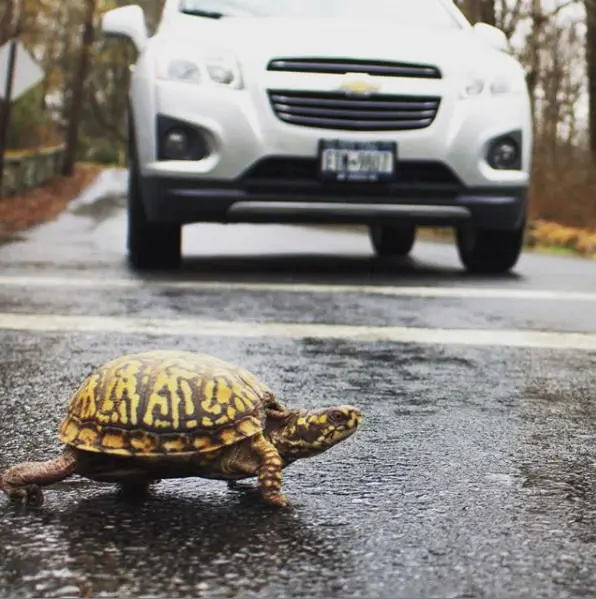
If a box turtle is crossing a road, the best action is usually to move it safely across the road in the direction it was already heading. But be careful. Do not put yourself in danger from traffic to help a turtle. Pull over only if it is safe, watch for cars, and never step into traffic assuming drivers will see you.
If you can help safely, move the turtle only a short distance, across the road, in the direction it was already going. Do not take it home. Do not move it to a park miles away. Do not decide that a nearby patch of woods looks better than the place the turtle was trying to reach.
Short-distance assistance can help. Long-distance relocation can create problems.
That distinction is important because conservation is not always about doing more. Sometimes it is about doing less, but doing the right thing at the right moment.
For box turtles, the right thing is often simple: Help them across the road safely. Then let them stay home.
Reference:
Hester, J. M., S. J. Price, and M. E. Dorcas. 2008. Effects of relocation on movements and home ranges of eastern box turtles. Journal of Wildlife Management 72:772–777. DOI: 10.2193/2007-049.