
Part 5 of Evolution After Arrival
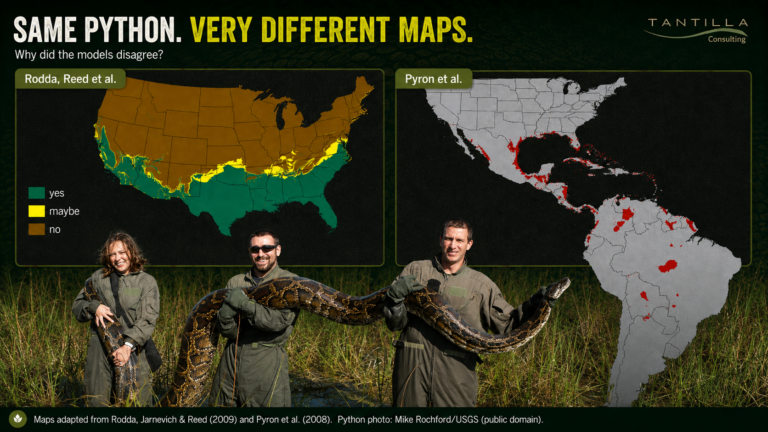
Few scientific maps have stirred more public anxiety about Burmese pythons than the one published by Gordon Rodda, Catherine Jarnevich, and Robert Reed in 2009. Their climate-suitability analysis suggested that large parts of the southern United States might offer conditions suitable for these snakes, with future climate scenarios extending suitable areas even farther north. For many readers, the obvious question was: Could Burmese pythons really spread all the way to Washington, D.C.?
Then came a second paper that seemed to offer reassurance.
In 2008, R. Alexander Pyron, Frank Burbrink, and Timothy Guiher published a dramatically different map. Their model suggested that suitable conditions in the United States were largely confined to South Florida and a few other small areas. If the Pyron map was right, the broad range suggested by Rodda and colleagues looked badly overstated.
But even before digging into the technical details, something about the Pyron map seemed odd.
You do not have to be a climate modeler—or even a snake biologist—to notice that climate is not normally distributed in tiny, disconnected fragments. The map implied that Burmese pythons might find suitable conditions in rainforests of Nicaragua and Panama, yet not Costa Rica. It also identified only scattered patches within the enormous Amazon Basin. Biologically, that pattern raised an obvious question: was the model really capturing the snake’s climatic tolerances, or was something about the modeling process producing an artificial pattern?
There was another reason for skepticism. Pyron and colleagues were not the only researchers to use a different approach from Rodda’s group.
In 2009, Nicola van Wilgen, Núria Roura-Pascual, and David Richardson published a broader analysis of climate matching for introduced reptiles and amphibians. Their method differed from Rodda and colleagues’, yet their result for Burmese pythons was broadly similar: substantial portions of the southeastern United States were identified as climatically suitable, along with parts of the Pacific Northwest coast of the United States and Canada.
That does not prove either broad prediction was correct. But it matters. Two different modeling approaches produced relatively broad areas of potential climatic suitability. Pyron’s model produced the strikingly different result—an extremely restricted and fragmented distribution.
So why did it differ?
The studies used different assumptions and different ways of translating occurrence records and climate data into predictions. Rodda, Jarnevich, and Reed used a climate-envelope approach based primarily on temperature and rainfall near the edges of the python’s native range. Van Wilgen and colleagues used a separate quantitative climate-matching method. Pyron, Burbrink, and Guiher used MaxEnt, a statistical niche-modeling approach incorporating numerous climatic variables and mapped occurrence records.
A more complex method can sound inherently more rigorous. But greater complexity does not automatically produce a more reliable biological prediction.
That became much clearer in 2011, when Rodda, Jarnevich, and Reed examined the disagreement in detail. They found that the Pyron result was highly sensitive to both modeling choices and the data supplied to the model.
The most memorable problem involved the occurrence records. Four of the 90 locality records used in the Pyron analysis did not represent Burmese or Indian pythons at all. They represented another species, the Blood Python. When those four erroneous points were removed and the model was rerun, the prediction changed dramatically. Rodda and colleagues concluded that those four records were responsible for the model’s prediction that essentially no additional portions of the U.S. mainland were climatically suitable.
Four erroneous locality records had helped produce a remarkably reassuring map.
The 2011 reanalysis found other problems as well. The MaxEnt results were highly sensitive to the geographic background selected and to which occurrence records were included. Rodda and colleagues also identified concerns about overfitting, multicollinearity among climate variables, and the large number of parameters generated by the model.
In simpler terms, the model could produce an impressively precise-looking map while that apparent precision depended heavily on how the analysis was constructed.
That is an important lesson about predictive maps. A map containing narrow patches and sharply defined boundaries can look more rigorous than a broad climate envelope. But sometimes that apparent precision reflects a model fitted too tightly to a particular dataset rather than a more accurate description of biological reality.
None of this means the Rodda map—or the van Wilgen prediction—should be interpreted literally. They do not predict that Burmese pythons will eventually occupy every area identified as climatically suitable. Climate is only one component of establishment. Habitat, hydrology, prey, extreme weather, dispersal, source-population physiology, and other factors still matter.
What is significant is that the broader prediction did not disappear when another research group approached the problem differently. Van Wilgen and colleagues independently obtained a broadly similar result. And when Rodda, Jarnevich, and Reed later tested alternative datasets and modeling choices, the broad climatic signal proved considerably more robust than the highly restrictive Pyron prediction.
That is what makes these maps such a useful case study. Models are not pictures of the future. They are products of decisions—what data to include, which variables to use, what assumptions to make, how much complexity to allow, and how to interpret the output.
The controversy was therefore about more than where Burmese pythons might spread. It was also about how much confidence we should place in a model simply because its answer looks precise—or happens to be reassuring.
Sometimes the frightening map deserves skepticism. But sometimes the reassuring map deserves even more.
Selected References
Pyron, R.A., Burbrink, F.T. & Guiher, T.J. 2008. Claims of potential expansion throughout the U.S. by invasive python species are contradicted by ecological niche models. PLoS ONE 3: e2931.
Rodda, G.H., Jarnevich, C.S. & Reed, R.N. 2009. What parts of the US mainland are climatically suitable for invasive alien pythons spreading from Everglades National Park? Biological Invasions 11: 241–252.
van Wilgen, N.J., Roura-Pascual, N. & Richardson, D.M. 2009. A quantitative climate-match score for risk-assessment screening of reptile and amphibian introductions. Environmental Management 44: 590–607.
Rodda, G.H., Jarnevich, C.S. & Reed, R.N. 2011. Challenges in Identifying Sites Climatically Matched to the Native Ranges of Animal Invaders. PLoS ONE 6: e14670.