
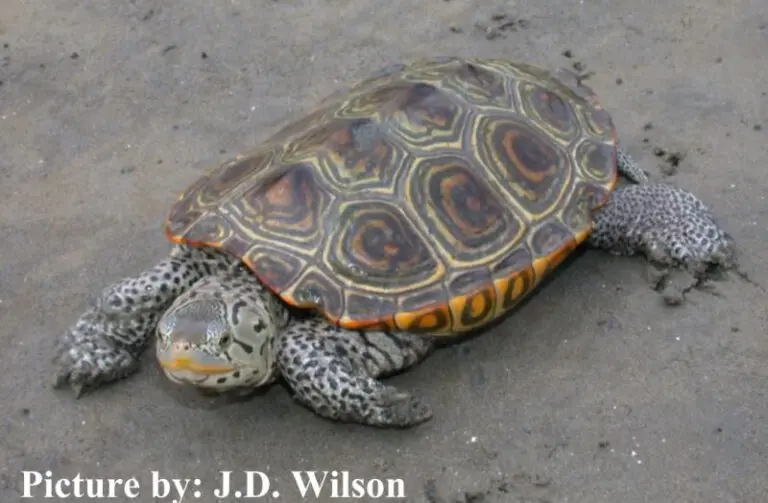
In 1983, J. Whitfield “Whit” Gibbons began a long-term mark-recapture study of terrapins living in the tidal creeks around Kiawah Island.
The project is still going.
Kristen Cecala and Cris Hagen, who now lead the work, recently captured a female terrapin at Terrapin Creek that was first captured and marked in 1986.
She has been part of the scientific record for 40 years. Based on her size and growth rings on her shell, she was estimated to be at least seven years old when first captured and marked, making her likely at least 47 years old now.
That is remarkable by itself, but the recapture also illustrates something important about long-term ecological research. A study lasting a few years can tell us where animals live, what they eat, how quickly they grow, or how they behave. But questions about longevity, lifetime survival, demographic change, and population trends can only be answered by continuing to return year after year.
No three-year grant can produce a 40-year recapture.
The Kiawah project has continued because people kept it alive. Whit began it more than four decades ago. Many students, researchers, friends, and collaborators contributed over the years. Kristen and Cris have now taken responsibility for carrying the work forward. I am tremendously pleased to see them continuing what Whit started—and still finding animals whose histories reach back to the earliest years of the study.
A marked turtle is more than an identification number. Every time that animal is recaptured, another chapter is added to a life history that would otherwise remain invisible.
This female has now connected researchers working in 1986 with researchers working in 2026.
That is the value of long-term research.
You cannot reconstruct it later.
You have to keep going.
This Insight is part of my ongoing LinkedIn series on reptiles, amphibians, conservation biology, invasive species, and scientific writing. Follow Michael E. Dorcas on LinkedIn for new posts and discussion.