
Part 4 of Evolution After Arrival
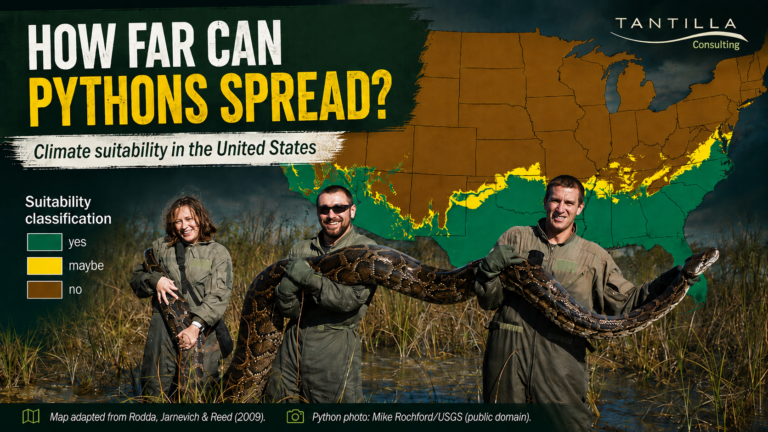
Burmese pythons, one of the largest snakes in the world, are now firmly established across a large portion of South Florida. But ever since the population began expanding, a larger question has hovered over the invasion: How far could they eventually spread?
One way scientists approach questions like this is through climate modeling. The basic idea is fairly intuitive. Determine the climatic conditions that a species experiences within its native range—typically using variables such as temperature, rainfall, and seasonality—and then look for other places where similar combinations of conditions occur. For an invasive species, the resulting map can identify regions where climate may permit the animal to survive and reproduce.
But there is an important distinction that is easily lost once a colored map appears on a computer screen: a climate-suitability map is not a prediction that the species will eventually occupy everything shown on the map. It is an estimate, based on a particular set of assumptions, of where climate may not prevent the species from occurring.
And those assumptions matter enormously.
From tropical forests to the Himalayan foothills
Burmese pythons provide an especially interesting case because their native distribution covers an enormous and environmentally diverse portion of Asia. The species occurs from tropical regions of Southeast Asia, including Vietnam, Cambodia, Laos, and Thailand, into warmer temperate regions of China and Nepal. In Nepal, Burmese pythons occur in lowland and foothill habitats associated with the Himalayan region. Across this immense geographic range they inhabit wetlands, river valleys, forests, grasslands, and rocky foothills.
That alone tells us something important: Burmese pythons are not simply animals of hot, wet tropical swamps.
To build a climate model, researchers can take climatic measurements from locations across that native distribution and describe the range of temperatures and moisture conditions associated with the species. Those conditions form what is often called a climatic envelope or climatic niche. We can then ask where similar combinations occur in another part of the world.
Conceptually, it is something like laying the climate of the Asian native range over a map of North America and asking: Where do the environmental numbers match?
That sounds straightforward. The biology underneath it is not.
What actually limits the native range?
One of the most important assumptions behind this approach is that climate helps explain why the animal occurs where it does.
Suppose Burmese pythons disappear toward one edge of their Asian range because winters beyond that point become physiologically intolerable. In that case, temperatures near the edge of the range provide useful information about the snakes’ climatic limits.
But suppose they disappear for some entirely different reason. Perhaps prey becomes scarce. Perhaps habitat changes. Perhaps predators, competitors, parasites, or diseases become more important. A mountain range or other geographic barrier may simply have prevented the animals from dispersing farther. Human activity can also truncate a distribution that historically extended beyond its current boundaries.
If something other than climate establishes the edge of the native range, then the climate observed at that edge may not represent the species’ physiological limit at all.
Ecologists often distinguish between a species’ realized niche—the conditions under which we actually observe it living—and its fundamental niche—the broader set of conditions under which it could potentially survive and reproduce if other ecological constraints were removed. An invasive species enters a new ecological setting in which some of those constraints may be missing.
That creates a somewhat counterintuitive possibility: a climate model based on the native distribution can actually underestimate the potential range of an invasive species. If predators, competitors, geographic barriers, or some other factor prevented an animal from occupying otherwise tolerable climates in its native range, those constraints may disappear when humans transport it to another continent.
Of course, climate models can overestimate range as well. Two places can have similar temperature and rainfall patterns while differing enormously in habitat, prey, refuges, hydrology, nesting opportunities, or other ecological requirements. Climate may indicate survival is possible even though the landscape does not.
But which Burmese python are we modeling?
There is another assumption that is particularly intriguing in the case of Burmese pythons.
The species’ native range stretches from tropical Southeast Asia to considerably cooler regions near the Himalayan foothills. But that does not necessarily mean that every Burmese python is physiologically identical across that enormous range.
Imagine a python from Vietnam and one from Nepal. They could look essentially identical to us while having very different physiological responses to cold. Populations living for thousands of generations under different climatic regimes can accumulate genetic differences affecting physiology, behavior, seasonal activity, or other traits without evolving obvious differences in external appearance.
Has that actually been demonstrated for cold tolerance in Burmese pythons? Not yet, as far as I can determine. I could find no study directly comparing the thermal physiology of Burmese pythons from Nepal with those from Vietnam or other tropical portions of the native range.
There is, however, growing evidence that native Burmese python populations are genetically structured. A recent genomic study found substantial differentiation between a Vietnam-derived lineage and native pythons from Hainan, China, even though morphological differences between geographic populations can be subtle. Earlier studies have likewise detected geographic genetic structure among Chinese populations. Thus, it is reasonable to suspect that biologically meaningful geographic variation may exist, but the relevant physiological comparisons have not yet been made.
That matters enormously when we try to predict the potential distribution of Florida’s pythons.
Where did Florida’s pythons come from?
The answer is less certain than one might expect.
Florida’s population ultimately originated through the commercial pet trade, but tracing those animals back to particular wild populations in Asia is difficult. The most comprehensive recent review concluded that ancestors of the Florida population are thought to have originated primarily from Thailand and Vietnam, based largely on import history. Yet international trade records show substantial numbers of Burmese pythons arriving in the United States from several Asian countries, captive breeding became common, and snakes from different sources could have been mixed before either escaping or being released.
Genetic evidence makes the story even more complicated. Researchers analyzing hundreds of Florida pythons found multiple genetic lineages, including mitochondrial evidence associated with Indian pythons, although the animals themselves are morphologically Burmese pythons. The most likely explanation involves historical mixing before the Florida invasion, but researchers have emphasized that much more genetic information from native populations and the commercial trade is needed to reconstruct the population’s ancestry reliably.
So we cannot simply assume that today’s Florida population represents all of the biological variation found across the Burmese python’s enormous Asian range.
If Florida’s founding snakes came predominantly from warmer parts of Southeast Asia, a climate model based on the entire native range—including populations from much colder environments—could overestimate the immediate cold tolerance of the Florida population. On the other hand, if the founding population contains ancestry from multiple geographically distinct populations, that mixture could provide genetic variation on which natural selection can act.
And, as the previous installment in this series showed, natural selection appears to have already acted on the Florida population following the severe freeze of 2010.
Climate is not weather
Another limitation is the difference between long-term climate and individual weather events. A region might have average winter conditions that appear suitable yet occasionally experience a severe freeze capable of killing large numbers of snakes.
We have already seen how important such events can be. During the January 2010 freeze in South Florida, many Burmese pythons died. In our South Carolina study, pythons survived remarkably cold conditions for considerable periods but ultimately died during an unusually severe winter. Some animals also failed to use available underground refugia appropriately when extreme cold arrived.
An event lasting only a few days can therefore have enormous biological consequences even if long-term climatic averages appear suitable. But those events can do something else as well: they can impose natural selection.
The population that survives repeated freezes may not be biologically identical to the population that encountered the first one.
The animal itself can change
Most distribution models necessarily begin by treating the organism’s climatic tolerance as something we can estimate from its present distribution. But biological invasions unfold over decades and centuries, and populations are not necessarily static during that time.
Individuals can acclimatize. Behavior can change. Genetic variation already present in a population can allow natural selection to favor individuals better suited to new conditions. Mixing among lineages can introduce additional variation. As an invasion moves into new environments, the population at the expanding edge may eventually differ from the population that originally became established.
None of this means Burmese pythons will inevitably evolve the ability to withstand winters hundreds of miles farther north. Evolution has constraints, and severe cold may remain a formidable barrier.
It does mean that the climatic tolerance of the South Florida python population today should not automatically be treated as an immutable property of the species for the next century.
So what does a climate model tell us?
Climate models are enormously useful. They allow researchers to turn geographic observations into testable predictions, identify regions that deserve surveillance, and ask systematically where temperature and moisture might permit an invasive species to persist.
But they are not crystal balls. Their predictions depend on what variables are included, which native localities are used, whether climate actually limits the native distribution, whether populations differ geographically, which of those populations founded the invasion, how extreme weather differs from climatic averages, and whether the invasive population changes after establishment.
For Burmese pythons, perhaps the most useful question is therefore not simply, “How far north can they spread?”
It is: “What currently prevents them from spreading farther—and are those barriers permanent?”
Once researchers began using climate models to answer that question, something fascinating happened. Different approaches produced remarkably different pictures of the python’s potential range in the United States.
Why they differed—and what happened when those predictions were examined more closely—is where we will pick up the story next.
Selected References
Guzy, J.C., et al. 2023. Burmese pythons in Florida: A synthesis of biology, impacts, and management tools. NeoBiota 80: 1–119.
Hunter, M.E., Johnson, N.A., Smith, B.J., et al. 2018. Cytonuclear discordance in the Florida Everglades invasive Burmese python (Python bivittatus) population reveals possible hybridization with the Indian python (P. molurus). Ecology and Evolution 8: 9034–9047.
Qing, J., Zhai, X., Yu, S., Tu, F., Wang, T. & Wang, J. 2025. Significant genetic differentiation between native and introduced farmed Burmese pythons and low risk of genetic introgression from escaped farmed individuals in Hainan Island. Conservation Science and Practice 7: e70005.