
One of the most important lessons from major snake invasions is how long it can take ecological reality to become scientifically and publicly accepted.
The brown tree snake invasion on Guam and the Burmese python invasion in the Florida Everglades followed surprisingly similar — but also importantly different — trajectories in this regard.
On Guam, biologists began documenting severe bird declines long before the broader scientific community fully accepted that an introduced snake could be responsible. Julie Savidge arrived on Guam to investigate why native forest birds were disappearing and eventually demonstrated that predation by invasive brown tree snakes was driving the collapse of the island’s avifauna.
Today this seems obvious in retrospect.
At the time, however, many researchers found the idea difficult to accept. Brown tree snakes were known to be present, but the notion that an introduced snake could restructure an entire island ecosystem — and drive widespread bird declines at landscape scales — seemed implausible to many people.
A somewhat different progression occurred in Florida.
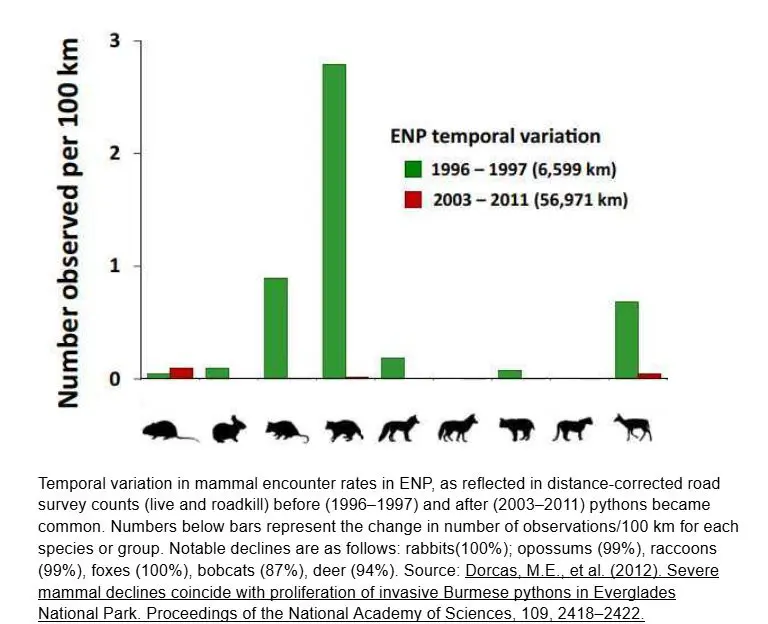
In our 2012 PNAS paper, we documented severe declines in mammal observations that coincided geographically and through time with python proliferation in Everglades National Park. Those road-survey comparisons provided evidence consistent with a python effect, but they did not experimentally isolate its cause. A later marsh-rabbit study by McCleery and colleagues provided more direct evidence: pythons accounted for 77% of recorded rabbit deaths following translocation into the park.
Burmese pythons were documented in south Florida for years before reproduction and establishment within Everglades National Park were fully recognized. However, once established populations became evident, severe mammal declines were documented relatively quickly. Only a little more than a decade after recognition of a reproducing population in Everglades National Park, severe declines in multiple mammal species had already become apparent (see Figure below).
Yet even with the lessons from the brown tree snake invasion on Guam, many scientists and laypeople were still reluctant to accept that pythons could affect prey populations so dramatically. As a result, many attempted to develop alternate — and sometimes rather fanciful — explanations for the severe mammal declines.
Part of the challenge in both systems is that snakes are inherently difficult to study. Snakes are cryptic, intermittently active, difficult to detect, and capable of persisting at what might appear to be low densities while still exerting substantial ecological effects.
Both Guam and the Everglades illustrate an important lesson in invasion biology: ecological change can occur long before society fully recognizes either the scale of the invasion or the mechanisms driving its impacts.
References
Dorcas, M. E., et al. 2012. Severe mammal declines coincide with proliferation of invasive Burmese pythons in Everglades National Park. Proceedings of the National Academy of Sciences 109:2418–2422. https://doi.org/10.1073/pnas.1115226109
Savidge, J. A. 1987. Extinction of an island forest avifauna by an introduced snake. Ecology 68:660–668. https://doi.org/10.2307/1938471
McCleery, R. A., Sovie, A., Reed, R. N., Cunningham, M. W., Hunter, M. E., & Hart, K. M. 2015. Marsh rabbit mortalities tie pythons to the precipitous decline of mammals in the Everglades. Proceedings of the Royal Society B 282:20150120. https://doi.org/10.1098/rspb.2015.0120
This Insight is part of my ongoing LinkedIn series on reptiles, amphibians, conservation biology, invasive species, and scientific writing. Follow Michael E. Dorcas on LinkedIn for new posts and discussion.