
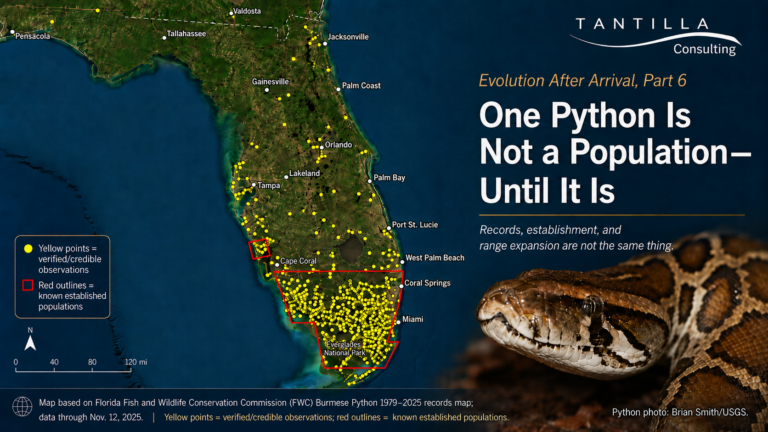
A Burmese python turns up well north of the Everglades. Has the species expanded its range?
Not necessarily.
A snake in a new place tells us that a python was there. It does not tell us how it arrived, whether others are nearby, whether they are reproducing, or whether a self-sustaining population exists.
A python can reach a new place through natural dispersal—or through a separate escape or release. A dot on a map cannot tell us which happened.
There is another complication: Burmese pythons are extraordinarily difficult to detect.
Nafus, Mazzotti & Reed (2020) estimated visual-survey detection probabilities of only 0.0001–0.0146, depending on how survey effort was defined. In lay terms, the upper end—1.46%—is roughly one detection in 68 comparable opportunities to detect a python that is present. At the lower end—0.01%—it is about one in 10,000.
Put another way, even at the more optimistic estimate, surveyors could miss a python about 67 times for every comparable opportunity in which they detect one. That does not literally mean someone walks past 67 snakes for each one found—the estimate depends on survey design and effort—but it conveys how easy pythons are to miss.
That creates a recognition lag. A small population may be living and reproducing in an area for years before enough animals are observed for us to say, “Maybe there is a population here.” By then, it may already be well established.
FWC acknowledges this problem: because pythons are so cryptic, it can take time to gather enough evidence to confirm a new area of establishment.
Western Charlotte County illustrates the issue. Pythons have been reported there since 2015, and wildlife officials now recognize a smaller established population there. But that does not necessarily mean the main South Florida population simply expanded northward; it may instead have arisen from separate introductions that subsequently became established.
So an isolated occurrence, repeated observations, a reproducing population, an established satellite population, and natural range expansion are not interchangeable.
That is why the scattered yellow dots on this map should not be read as the python’s established range. They represent verified or credible observations. The red outlines show known established populations—not necessarily every established population that actually exists.
Climate models tell us where pythons might survive. Sightings tell us where individual snakes have been found. Establishment tells us where populations are known to persist. Range expansion asks something else: is a population actually spreading?
That is where Part 7 will go next.
Reference: Nafus, M.G., Mazzotti, F.J. & Reed, R.N. 2020. Journal of Herpetology 54:24–30. doi:10.1670/18-154.
#BurmesePython #InvasionBiology #ConservationBiology #Florida #TantillaInsights