
One of the more subtle challenges in ecology is that the most important effects are often indirect.
We tend to focus on what is easiest to observe: which species are present, which species decline, which species increase.
But ecosystems are networks of interactions. When one part changes, the effects can propagate in unexpected ways.
A predator does not just reduce its prey. It can alter the abundance, behavior, and ecological roles of other species, often with consequences that are not immediately obvious.
A nice example comes from John D. “J.D.” Willson’s study of invasive Burmese pythons in South Florida, which examined how python-driven declines in mammals affected predation pressure on turtle nests.
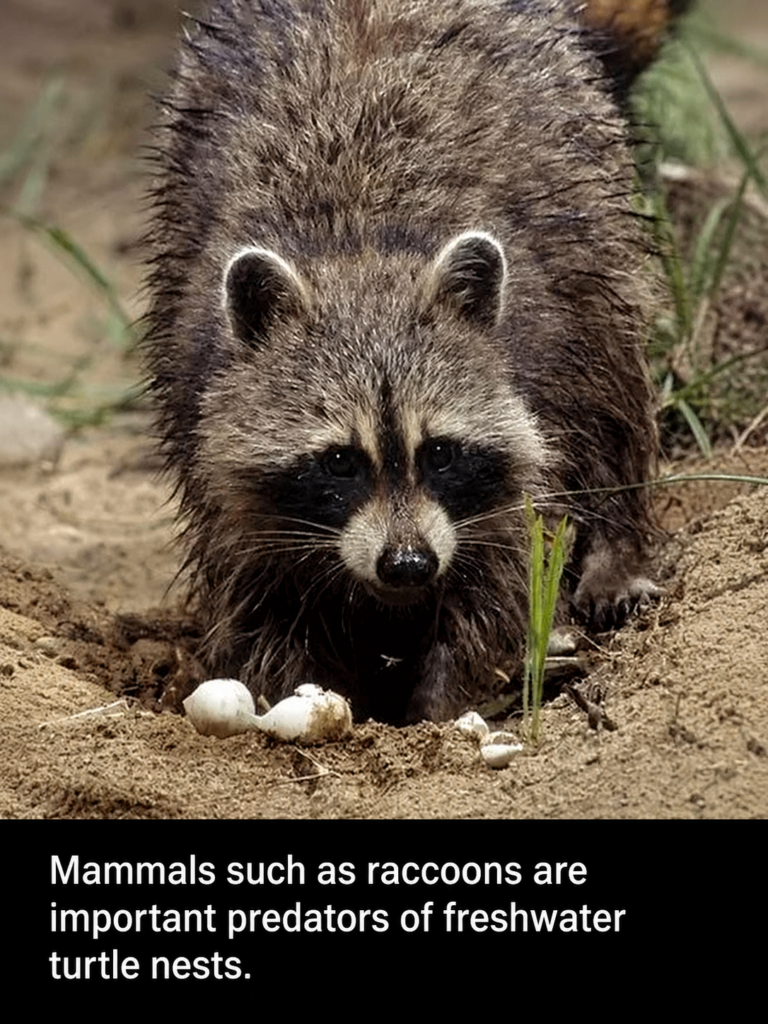
The logic was straightforward. In many freshwater turtle populations, nests are heavily depredated by mammals such as raccoons and opossums. Those are exactly the kinds of mid-sized mammals that declined dramatically in parts of the Everglades after Burmese pythons became established.
So J.D. asked a simple but important question:
If pythons reduce populations of mammalian nest predators, do turtle nests experience less predation?
To test this, he and his team placed artificial freshwater turtle nests across sites that differed in python invasion history. Some sites were in areas where pythons had been established for many years. Others were in areas where pythons were less common or not yet established. The nests were monitored with wildlife cameras so that researchers could identify which animals found and depredated them.
The result was striking.
Nest predation was much lower in areas where pythons were most established. Those sites had fewer mammalian nest predators and fewer nest attacks. In areas where pythons were absent or less established, mammalian nest predators were still common, and nest predation was much higher.
These were artificial nests, so the study measured differences in nest-predation pressure rather than the survival of natural turtle nests. The results suggest a possible indirect benefit from fewer mammalian nest predators, but they do not by themselves demonstrate increased turtle recruitment or larger turtle populations.
In other words, by reducing mammals that eat turtle eggs, Burmese pythons may indirectly increase turtle nest success.
That is not a simple “good news” story.
Burmese pythons have had severe negative effects on many native mammals in the Everglades. But ecosystems do not respond in simple one-directional ways. When one group of animals declines, another group may experience reduced predation, altered competition, or changed recruitment.
For turtles and perhaps other egg-laying species, the loss of mammalian nest predators could increase nesting success. But that benefit comes from a major disruption of the food web. It also does not mean that the overall effect of pythons is positive. It means the effect is complicated.
That is the important lesson.
The ecological impact of an invasive predator is not limited to the animals it eats. It can ripple through the system by changing who eats whom, which life stages survive, and which interactions remain intact.
In the Everglades, pythons are not simply removing mammals.
They are changing the structure of ecological relationships.
And more broadly, this highlights a point that extends well beyond ecology: in complex systems, focusing only on direct effects can miss the mechanisms that matter most.
Reference:
Willson, J. D. 2017. Indirect effects of invasive Burmese pythons on ecosystems in southern Florida. Journal of Applied Ecology 54:1251–1258. https://doi.org/10.1111/1365-2664.12844
This Insight is part of my ongoing LinkedIn series on reptiles, amphibians, conservation biology, invasive species, and scientific writing. Follow Michael E. Dorcas on LinkedIn for new posts and discussion.