
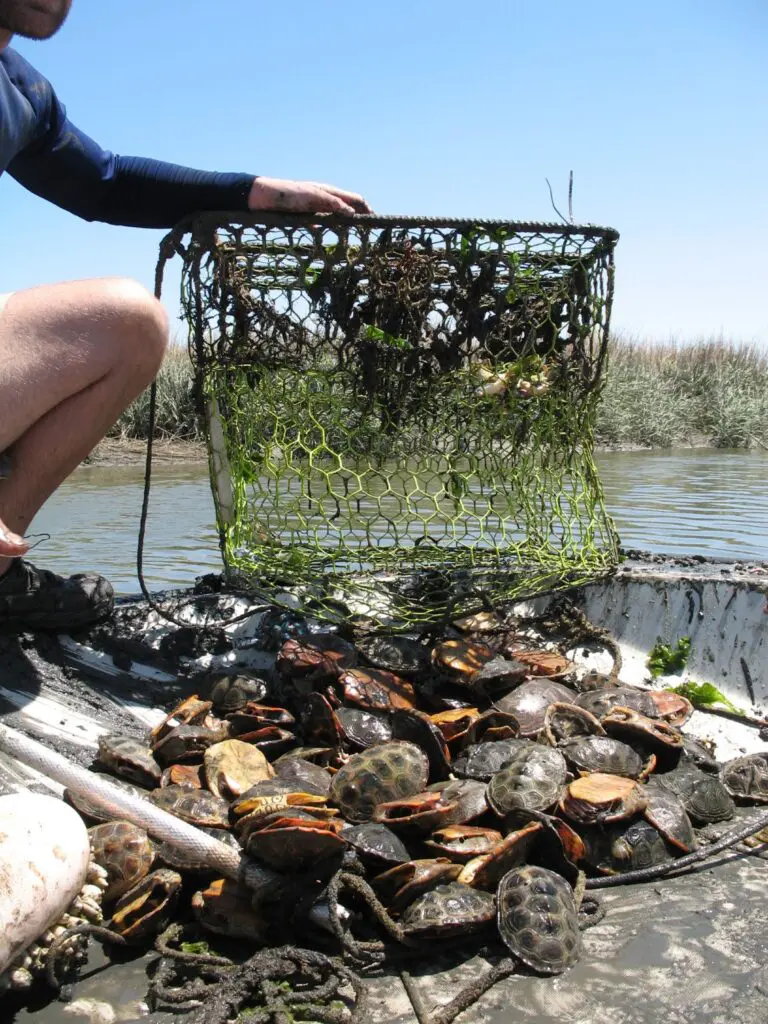
Sometimes the best bait for a turtle may be another turtle.
That is not a management recommendation. It is a warning.
Anyone who has trapped turtles for research has probably seen this. A turtle enters a trap, and soon other turtles are swimming around it, investigating the trap and trying to get inside.
I have seen this with pond turtles such as painted turtles. In those cases, we were trapping turtles intentionally, checking traps frequently, and setting them so the turtles could breathe.
Crab pots are different.
A diamondback terrapin entering a submerged crab pot often cannot escape before drowning. In warm summer water, turtles have higher metabolic rates and need more oxygen. A trapped terrapin may drown within just a few hours.
If one terrapin enters, others may be drawn to the same trap. One trapped turtle can make the trap more attractive to more turtles.
That helps explain why some crab pots contain not one dead terrapin, but many.
Professional crab trappers have told me that most pots do not capture terrapins. But every now and then, they pull up a pot with 25 or 30 dead terrapins inside.
Andrew Grosse and colleagues documented 133 dead terrapins in two abandoned crab pots in a Georgia tidal marsh over repeated visits. Initial observations included 94 dead terrapins in one pot and 23 dead terrapins, plus one live animal, in the other. Additional deaths raised the total to 133.
Using body-size measurements and population estimates, they estimated that neglected pots had removed 91% of the terrapin biomass in that creek. That is an estimated loss of biomass, not a direct count of 91% of the population.
That is the part people often miss. This is not just about one turtle dying in one trap.
Diamondback terrapins often show strong fidelity to particular tidal creeks. Some creeks may contain relatively small local populations. A single abandoned or poorly placed crab pot, sitting in the wrong creek at the wrong time, can remove a large portion of the local population.
A single crab pot can become a population-level mortality event.
This matters for both recreational and professional crabbing, but the scale is not the same. There are far more professional crab pots on the landscape. They are often deployed in prime terrapin habitat and may remain in the water longer.
Checking pots frequently can reduce some risks, but it does not eliminate them. If a terrapin can drown within a few hours, even a regularly checked pot can still be lethal.
That is why bycatch-reduction devices are so important. The best way to prevent terrapin drowning is not to hope the pot is checked in time. It is to keep the turtle from entering the pot in the first place.
Small changes in gear and behavior can help prevent very large losses.
One crab pot does not always kill one terrapin.
Sometimes one crab pot can doom an entire local population.
Reference:
Grosse, A. M., J. D. van Dijk, K. L. Holcomb, and J. C. Maerz. 2009. Diamondback terrapin mortality in crab pots in a Georgia tidal marsh. Chelonian Conservation and Biology 8:98–100. https://doi.org/10.2744/CCB-0729.1
This Insight is part of my ongoing LinkedIn series on reptiles, amphibians, conservation biology, invasive species, and scientific writing. Follow Michael E. Dorcas on LinkedIn for new posts and discussion.