Being a cotton rat in the Everglades is tough. There are a lot of animals out there trying to catch and eat you—hawks and other birds, bobcats and other mammalian predators, rattlesnakes, cottonmouths, rat snakes, and even young Burmese pythons.
So what is the best strategy for keeping yourself from becoming somebody else’s lunch? Should you be bold, quickly leaving cover and moving through the landscape, or cautious and shy? Is it safer to move around a lot, or to stay relatively sedentary and avoid attracting attention?
You might expect there to be some generally safest way for a prey animal to behave: be cautious, don’t move too much, and don’t attract attention. But there is a problem with that strategy: predators do not all hunt the same way.
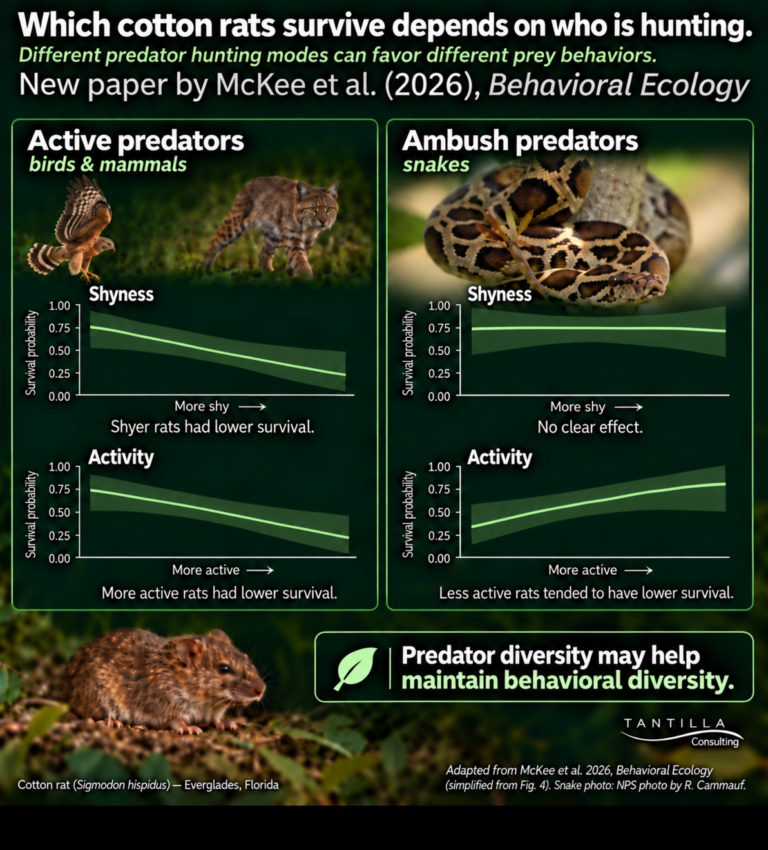
A new paper by Rebecca McKee and colleagues in Behavioral Ecology provides a particularly interesting field test of what that means. The researchers found that the relationship between a cotton rat’s behavior and its chances of surviving depended on what kind of predator was hunting it. Shyer and more active rats were at greater risk from actively hunting predators such as birds and mammals. With snakes, which the researchers classified as predominantly ambush predators, the pattern was different: shyness showed no clear effect, while less-active rats showed a tendency toward greater predation risk.
In other words, there may be no single “best” prey personality—and that could help explain why different behavioral types persist in animal populations.
I was especially pleased to see this paper because its first author, Rebecca K. McKee, was years ago one of my best undergraduate research students. It is gratifying to see her leading thoughtful field research that connects animal behavior, predator-prey ecology, and evolution.
What does “personality” mean in a cotton rat?
When behavioral ecologists talk about animal personalities, they are not assigning human personality types to animals. They are referring to consistent differences in behavior among individuals. Some individuals reliably behave more cautiously than others. Some move and explore more. Some respond more passively to handling. For those differences to be considered aspects of personality, they need to show at least some consistency across repeated observations.
McKee and colleagues tested that explicitly in hispid cotton rats (Sigmodon hispidus) from the Everglades. They measured three behavioral traits. Shyness was measured with an emergence test: a rat began inside the relative security of a trap connected to an open arena, and rats that took longer to emerge were considered more risk-averse, or shy. Activity was measured by placing the rat in an open-field arena and tracking how far it moved. Docility was assessed from its response to brief handling, with time spent immobile used as a measure of docility.
The researchers repeated behavioral trials on many animals and found that these measures were sufficiently repeatable to represent consistent individual differences rather than simply random behavior on a particular day.
Then came the part that makes this study especially valuable: they released the animals back into the Everglades and followed what happened to them.
Measuring personality – and then letting nature do the experiment
The researchers fitted radio collars with mortality sensors to 98 adult cotton rats and monitored them every 24 to 48 hours. When a rat died, they investigated the scene and attempted to identify the predator.
Snake predation could sometimes be particularly unambiguous: a radio transmitter might be located inside a snake, recovered after regurgitation, or found in snake scat. Mammalian predators left evidence such as tooth marks, tracks, or scat; avian kills could be identified from feathers, bird excretions, beak damage to collars, or characteristic remains.
During the study, 50 rats were killed by predators. Twenty-seven deaths were attributed to birds, six to mammals, 11 to snakes, and six to predators that could not be identified.
The researchers then grouped the identified predators according to their general hunting strategy. Birds and mammals were treated as relatively active predators—animals that search for or pursue prey. Snakes were classified toward the ambush end of the hunting spectrum.
That is necessarily a simplification. A hawk, bobcat, rattlesnake, rat snake, or python does not use precisely the same hunting strategy every time it feeds, and the authors acknowledge that. But at the broad level relevant to the study, endothermic birds and mammals generally search for prey more actively than the snake predators in this system.
That distinction turned out to matter.
Personality did not predict predation – until the predators were separated
One of the most interesting results is what the researchers didn’t find. If all predators were lumped together, shyness, activity, and docility did not significantly predict whether a cotton rat survived. That could easily have led to the conclusion that personality did not matter.
But lumping predators together concealed an important pattern.
When McKee and colleagues separated predators by hunting mode, relationships emerged. Among rats killed by birds and mammals, shyer animals had greater predation risk. A longer delay before emerging from the experimental refuge—a behavioral measure of shyness—was associated with an increased risk of being killed by an active predator. Activity showed another strong pattern: more active cotton rats were more likely to be killed by birds and mammals.
The authors offer a plausible explanation. A rat that moves more frequently or across greater distances may simply provide more opportunities for an actively searching predator to detect it. Red-shouldered hawks, which are common predators in the study system, are particularly well equipped to detect moving prey.
But with snakes, the relationship went in the opposite direction.
When moving less may not make you safer
Among the 11 cotton rats killed by snakes, less-active animals tended to have greater predation risk. That result was weaker statistically than the patterns involving active predators, so it should not be treated as a definitive rule. The number of snake predation events was relatively small, and the authors are appropriately cautious about the result.
Still, the direction of the pattern is intriguing. Many snakes hunt partly by using chemical cues left by prey. McKee and colleagues suggest that relatively sedentary rats might leave more concentrated or predictable scent cues in an area, potentially making them easier for an ambush predator to locate and target.
So consider the dilemma from the rat’s perspective. Moving a lot might make you more conspicuous to a hawk or mammal searching for prey, while moving very little might make your location more predictable to a predator waiting for prey to come within striking distance.
There is no universally safe strategy because the predators are asking different questions.
Predators can pull evolution in different directions
This is where the study becomes more than an interesting story about cotton rats. Natural selection is sometimes presented as though the environment is pushing a population toward a single optimal phenotype. But environments are rarely that simple. A behavioral trait that increases survival in one ecological context can decrease it in another.
If different predators preferentially remove different kinds of individuals, they may impose different—and potentially opposing—selection pressures on the same prey population. That is the idea behind what behavioral ecologists call the Predator Heterogeneity Hypothesis. Diversity among predators may help maintain behavioral diversity among prey because no single personality performs best against every predator.
McKee and colleagues’ results are consistent with that hypothesis. The study is especially valuable because much previous work linking prey personality to predator hunting style has been done under laboratory or simplified experimental conditions. This study followed animals released into a natural Everglades predator community, where cotton rats simultaneously faced birds, mammals, and snakes.
The results were also not quite what theory might have predicted. A long-standing idea called the Locomotor Crossover Hypothesis predicts that actively hunting predators should be especially effective against relatively sedentary prey, whereas ambush predators should disproportionately capture more active prey. McKee and colleagues found almost the reverse pattern for activity: more-active rats suffered greater risk from active predators, while less-active rats tended to fare worse against ambush predators.
That does not necessarily invalidate the broader theory. The authors point out that applying patterns observed among species to behavioral differences among individuals within a species may not be straightforward. Predator-prey relationships are also likely to depend on the particular species, habitat, sensory systems, and hunting tactics involved.
Biology is often more interesting when the animals refuse to follow the simple prediction.
The Everglades makes this question even more complicated
Cotton rats in the Everglades encounter an unusually diverse predator community. Native snakes that prey on them include eastern diamondback rattlesnakes, cottonmouths, and rat snakes. Young Burmese pythons also consume cotton rats. Birds of prey and mammalian carnivores add very different hunting strategies to that predator community.
McKee and colleagues did not test whether Burmese pythons specifically favor particular cotton-rat personalities. Their snake predation events were analyzed collectively, and that distinction is important. But the study raises a broader question that is particularly interesting in an invaded ecosystem.
If the composition of the predator community helps determine which prey behaviors are favored, then changing that predator community could potentially change the selective environment experienced by prey.
The establishment of Burmese pythons in South Florida has done more than add another snake predator. Python proliferation has coincided with major declines in several mammal species, and research increasingly suggests effects on some native mammalian predators as well. That means biological invasions could potentially influence natural selection in ways that extend beyond the direct mortality caused by the invading predator.
That possibility was not tested by McKee and colleagues, and at this point it should be viewed as a hypothesis rather than a conclusion from their study. But it follows naturally from their main result:
Who is doing the hunting matters.
If a predator community changes, the balance of selection pressures may change with it.
There may be no safest personality
One of the persistent questions in evolutionary biology is why populations retain so much variation. If one behavior is consistently better than another, natural selection should eventually make that behavior increasingly common.
But what if the answer to “Which behavior is best?” keeps changing?
A cotton rat that behaves in a way that reduces its chances of being detected by one predator may make itself more vulnerable to another. Predators using different sensory systems and hunting strategies can pull survival—and ultimately evolution—in different directions. That makes behavioral diversity easier to understand.
Perhaps there is no safest personality for a cotton rat.
There is only a personality that works better against the predator currently hunting it.
Reference
McKee, R. K., Miller, S., Keiser, C. N., Chester, M. P., Hart, K. M., & McCleery, R. A. 2026. Predator hunting modes induce varied selection pressures on prey personality. Behavioral Ecology 37: arag097. https://doi.org/10.1093/beheco/arag097