
If you see a photograph or video of a reticulated python (Malayopython reticulatus) being captured in Puerto Rico, it is easy to assume you are looking at an escaped or released pet.
For years, that was a reasonable explanation for individual giant constrictors found outside their native ranges. One snake does not make a population.
But at some point, repeated observations stop looking like isolated accidents. Adults turn up in different places. Young snakes appear. Wildlife agencies begin treating the animals as a population rather than a series of escapees.
Puerto Rico appears to have crossed that line with reticulated pythons.
Important questions remain. We do not have a reliable population estimate, a clearly defined range boundary, a published estimate of spread rate, or much information about ecological effects. But the more basic question—are reticulated pythons established and reproducing in the wild in Puerto Rico?—is now much easier to answer.
The evidence says yes.
This did not begin with the recent videos
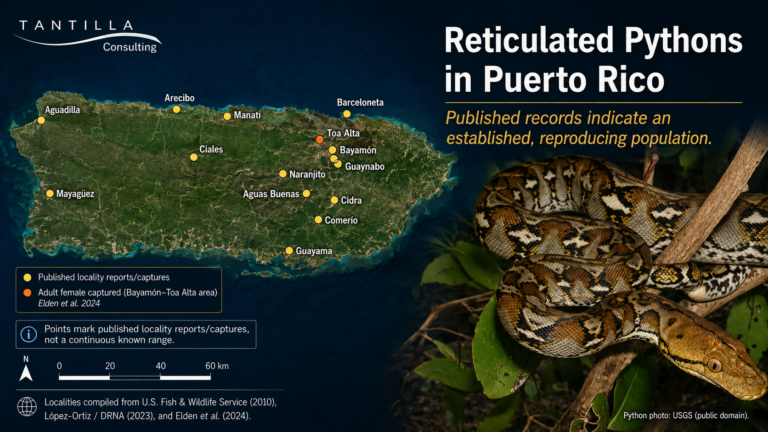
Free-ranging reticulated pythons have been documented in Puerto Rico for years. Federal records reported animals from Aguadilla, Mayagüez, and Guayama, including one approximately 5.5 m (18 ft) long. At that stage, those records could still reasonably have represented individual escapes or releases.
Reports continued. By 2023, Puerto Rico’s Department of Natural and Environmental Resources (DRNA) listed reticulated-python reports from several municipalities, including Aguas Buenas, Barceloneta, Bayamón, Cidra, Comerío, Guaynabo, and Naranjito. Preliminary university research likewise identified records from two broad areas of north-central Puerto Rico.
Those records should not be interpreted as a continuous known range. An occurrence map is not the same thing as a population boundary. But the observations clearly extend beyond a single isolated locality.
A 2024 account by Justin Elden and colleagues added more direct evidence. Eleven wild-caught reticulated pythons had been donated to the University of Puerto Rico at Mayagüez, including both adults and neonates. The researchers also captured a healthy 3.61-m (11.8-ft) adult female near the Bayamón–Toa Alta area.
Adults alone could still be released pets. Neonates, especially in combination with repeated adult records, make that explanation increasingly difficult.
Puerto Rico now recognizes a reproductive population
In June 2024, DRNA issued an administrative order addressing exotic snakes and explicitly identified wild reproductive populations of three nonnative species: boa constrictors (Boa constrictor), reticulated pythons, and striped keelbacks (Xenochrophis vittatus).
The scientific literature has since adopted the same assessment.
In 2026, Timothy Colston and colleagues published complete genome sequences for five invasive reptiles collected in Puerto Rico. They distinguished species merely verified in the wild from those known to be established and reproducing. Reticulated pythons were placed explicitly in the latter group.
The genome paper itself was not a population study and does not independently demonstrate reproduction. But together with neonatal specimens, repeated occurrence records, DRNA’s assessment, and ongoing field collections, the evidence is increasingly difficult to dismiss.
Puerto Rico does not simply have occasional reticulated pythons.
It has an established, reproducing population.
Where did they come from?
Preliminary genetic work may offer part of the answer.
Researchers Elsie Rivera-Ocasio, Yamilis Ortiz Deliz, and Alberto Puente-Rolón analyzed mitochondrial DNA from naturalized Puerto Rican reticulated pythons and found little or no variation among the animals sampled. Their mitochondrial haplotype matched one previously reported from Sumatra.
That pattern is consistent with a relatively narrow founding source followed by reproduction and spread in Puerto Rico. But mitochondrial DNA represents only one maternally inherited portion of the genome. It cannot tell us exactly how many founders were involved or whether apparently separate groups across the island are genetically connected.
A full peer-reviewed population-genetic analysis appears not yet to have been published. That work could be especially valuable for management because it may help distinguish a single spreading population from multiple independent introductions.
Puerto Rico has seen something like this before
Puerto Rico already has another established nonnative giant constrictor.
In 2013, Graham Reynolds and colleagues documented an established population of Boa constrictor near Mayagüez. More than 150 boas had been removed since 2011, and genetic analyses indicated a recently founded population derived from captive stock.
The authors also raised another important possibility: people may have moved boas across Puerto Rico, intentionally or unintentionally, allowing long-distance dispersal much faster than snakes could accomplish on their own.
Aruba provides another useful Caribbean comparison.
Boa constrictors were first documented there in 1999. Within several years, hundreds had been captured, including neonates, adults, and gravid females, and the snakes had spread widely despite an active removal program. Later genetic work indicated that the invasion probably began with only a small number of captive founders.
Puerto Rico and Aruba differ greatly, and boas are not reticulated pythons. Aruba should therefore not be treated as a prediction of what will happen in Puerto Rico.
But it illustrates an important principle: a small founding population of a cryptic snake does not necessarily remain small for long.
What we still do not know
Calling the Puerto Rican reticulated python population established does not mean we understand it well.
We do not know how many animals are present. More reports could reflect population growth, but they could also result from increased public awareness, more searching, and better reporting. Without standardized survey effort and detection estimates, observation counts alone cannot tell us population trends.
We also do not know the true geographic limits of the population. Several records identify areas of repeated occurrence, but they do not tell us where the population ends.
That matters especially for snakes. Difficult-to-detect animals can reproduce at low densities for years before enough observations accumulate for people to recognize what is happening. We should not simply transfer detection estimates from Burmese pythons in Florida to reticulated pythons in Puerto Rico, but the underlying problem remains: the range we observe may lag behind the range the snakes actually occupy.
We also know surprisingly little about ecological effects. Reticulated pythons are generalist predators, but predictions about what they might eat are not the same as demonstrating impacts. I have not found a published Puerto Rico diet study or a quantitative analysis of effects on native wildlife.
Movement, habitat use, reproduction, survival, and rate of spread likewise remain poorly understood.
What should happen next?
Puerto Rico appears to be at an important stage of this invasion: reproduction is established, but the size and extent of the population remain uncertain.
That creates two possible mistakes. One is to overstate the evidence and describe an island-wide invasion before we know that to be true. The other is to wait until an island-wide invasion becomes obvious before responding aggressively.
Neither is a good option.
What is needed now is systematic information: precise locations of captured animals; sex, size, and reproductive condition; tissue samples for genetic work; dietary data; and standardized search effort that records where snakes are not found as well as where they are.
Telemetry could clarify movement and habitat use. Population genetics could reveal connectivity among localities. Other detection methods, including environmental DNA, may eventually help if validated for this system.
Management also needs to be judged by more than the number of snakes removed. Capturing many animals can look successful while a population continues to reproduce and expand. The more important questions are whether removal is reducing abundance, slowing spread, preventing reproduction, or shrinking occupied areas.
One snake is not a population. This is no longer one snake.
An individual reticulated python collected in Puerto Rico years ago did not prove that an invasion had begun.
But evidence accumulates.
Repeated records across years and localities are different from one escape. Adults and neonates are different from adults alone. A wildlife agency documenting a wild reproductive population is different from speculation on social media. And a scientific publication recognizing the species as established and reproducing adds another layer of support.
The important question has therefore changed.
It is no longer simply “Can reticulated pythons establish in Puerto Rico?”
They apparently have.
The questions now are how extensive the population already is, how quickly it is spreading, what effects it is having, and whether management can still change its trajectory.
With invasive species, those questions are much better answered early than late.
References
Colston, T. J., et al. 2026. The complete genome sequences of 5 species of reptiles invasive in Puerto Rico. Biodiversity Genomes. DOI: 10.56179/001c.161013.
Departamento de Recursos Naturales y Ambientales de Puerto Rico. 2024. Orden Administrativa Núm. 2024-05: control de culebras exóticas. June 2024. Administrative order (PDF)
Elden, J. M., et al. 2024. Account of a non-native Malayopython reticulatus in Puerto Rico. Bulletin of the Chicago Herpetological Society 59:125–127.
Reynolds, R. G., Puente-Rolón, A. R., Reed, R. N., & Revell, L. J. 2013. Genetic analysis of a novel invasion of Puerto Rico by an exotic constricting snake. Biological Invasions 15:953–959. DOI: 10.1007/s10530-012-0354-2.
Rivera-Ocasio, E., Ortiz Deliz, Y., & Puente-Rolón, A. R. 2023. Genetic characterization of naturalized reticulated python (Malayopython reticulatus) in Puerto Rico. Seventh Puerto Rican Herpetology Symposium.
Quick, J. S., Reinert, H. K., de Cuba, E. R., & Odum, R. A. 2005. Recent occurrence and dietary habits of Boa constrictor on Aruba, Dutch West Indies. Journal of Herpetology 39:304–307.
Bushar, L. M., et al. 2015. Genetic characterization of an invasive Boa constrictor population on the Caribbean island of Aruba. Journal of Herpetology 49:602–610.
López-Ortiz, R. 2023. Estado actual en el manejo de la Pitón Reticulada. DRNA presentation, November 2023. DRNA presentation
#ReticulatedPython #InvasiveSpecies #PuertoRico #InvasionBiology #ConservationBiology #ReptileEcology #WildlifeManagement #TantillaInsights