
The first Gila monster I encountered in the wild was only about eight inches long, crossing a road at night in Arizona’s Santa Rita Mountains. It was tiny, beautifully patterned, and almost impossibly cute—hardly a monster at all.
The next day, I encountered a full-grown adult. Its heavy build, beadlike scales, and deliberate movements gave it an entirely different presence. The contrast stayed with me.
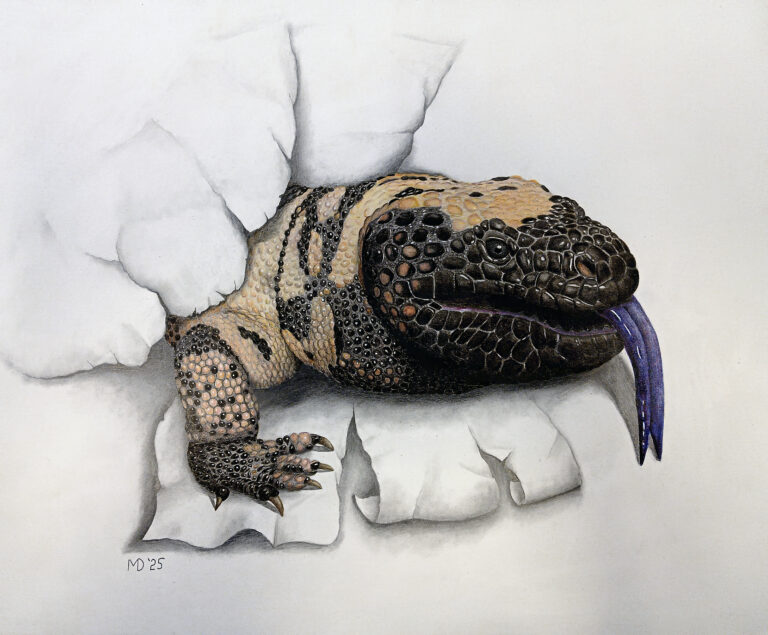
Years later, those encounters helped inspire Breaking Through. W. W. Lamar supplied the reference photograph, and I drew the animal appearing to tear through the paper with its blue-purple tongue extended—recreating the surprise of encountering one in the wild.
View Breaking Through at Tantilla Art:
https://tantillaart.com/portfolio/breaking-through/
Gila monsters (Heloderma suspectum) are the largest lizards native to the United States, reaching about 20 inches. Heloderma means “studded skin”—a reference to their beadlike scales.
They may spend 95–98% of their lives underground in burrows and rocky shelters. Most surface activity occurs in spring, with a smaller peak during summer monsoon rains. Encountering two on consecutive days was therefore extraordinary.
They feed largely on bird and reptile eggs, nestlings, and newborn mammals. Gila monsters locate food with their forked tongues, consume large meals, and store fat in their thick tails, allowing them to remain underground for long periods.
They are also the only venomous lizards native to the United States. Venom from glands in the lower jaw travels along grooved teeth as the animal bites and chews rather than being injected through hollow fangs like many snakes.
That venom also made an unexpected contribution to medicine.
In 1992, John Eng and colleagues isolated exendin-4, a 39-amino-acid peptide, from Gila monster venom. It activates the same receptor as the human hormone GLP-1, which helps regulate blood glucose, but resists rapid breakdown and remains active much longer. A synthetic version became exenatide, approved in 2005 as the first GLP-1 receptor agonist for treating type 2 diabetes.
Today’s GLP-1 drugs are not all made from Gila monster venom. Semaglutide, for example, is an engineered analog of human GLP-1. But exendin-4 led directly to exenatide and helped establish the potential of longer-acting GLP-1 receptor agonists.
That is one reason I love natural history. A small lizard crossing a desert road can become a lasting memory, inspire art, and—through basic biological research—become part of the story behind an important class of medicines.
Breaking Through, graphite and colored pencil on Bristol board, 17 × 14 inches. Reference photograph courtesy of W. W. Lamar.
References:
Eng et al. 1992: https://pubmed.ncbi.nlm.nih.gov/1313797/
Furman 2012: https://pubmed.ncbi.nlm.nih.gov/21194543/
Lau et al. 2015: https://pubmed.ncbi.nlm.nih.gov/26308095/
More essays:
https://tantillaconsulting.com/insights/
#GilaMonster #NaturalHistory #GLP1 #ScienceAndArt