
When I was younger and living in the Dallas–Fort Worth area, I kept a lot of reptiles. Over roughly eight to ten years my collection included boa constrictors, Burmese and reticulated pythons, rainbow boas, tegus, Nile monitors, tokay geckos, Jackson’s chameleons, and others. The animal that probably stands out most in my memory is a reticulated python that reached about ten feet long. The tegu was a beast of an animal, although remarkably gentle. Not all tegus are, and a serious bite from a large one is something worth avoiding.
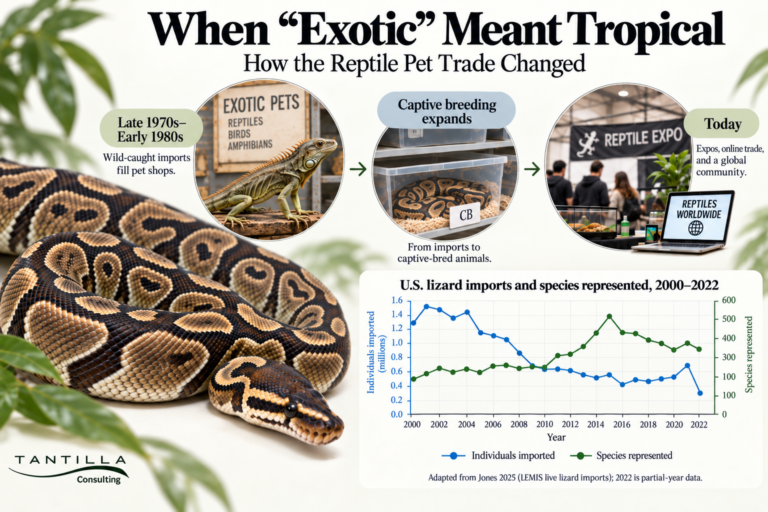
I bought my reptiles from pet stores. This was the late 1970s and early 1980s, when captive breeding was far less developed and many reptiles available in stores had been collected from the wild and imported. I gave relatively little thought then to exactly where those animals had come from. What I did notice was that many imported reptiles arrived in terrible condition—thin, dehydrated, heavily parasitized, or otherwise unhealthy—and many died. Anyone who kept reptiles during that period probably remembers how different that was from buying a healthy, well-started captive-bred animal today.
There was another assumption that seemed almost self-evident at the time. These animals were “exotic,” which in our minds largely meant tropical. If one somehow escaped in the United States, surely winter would eventually take care of it.
Many years later, as a professional herpetologist, I began hearing about exotic reptiles not merely surviving in South Florida but reproducing and establishing populations there. That eventually became an important part of my own research. What is especially striking to me now is that every one of the reptiles I listed above is now known to have established, reproducing populations somewhere in the United States or its territories, including Florida, Georgia, Hawai‘i, and Puerto Rico.
The animals had not changed nearly as much as our understanding of them had. But the pet reptile trade itself had changed dramatically.
A very different reptile trade
A recent Comment in Nature by Neil Vora and colleagues examines the modern international trade in reptiles and amphibians and argues that regulatory systems have not kept pace with it. My focus here is mostly on reptiles, but reptile and amphibian keeping overlap substantially. Many of the same hobbyists, breeders, dealers, online sellers, and expos include frogs, salamanders, and newts alongside snakes, lizards, turtles, and other reptiles.
Reading the Vora article made me wonder just how different today’s trade is from the one I knew when, as a kid, I started keeping snakes and lizards.
My first guess was that imports into the United States must simply have continued increasing. Reptile keeping is much more visible now, the variety of animals available is extraordinary, and the Internet makes finding unusual species easier than I could have imagined while browsing local pet stores.
The numbers tell a more complicated story. Corn and colleagues (2011), summarizing earlier U.S. trade data, reported that about 1.7 million live reptiles were imported into the United States in 1970. Imports declined following expanded wildlife protections during the 1970s and later rose again as reptile keeping grew in popularity. By 1995, about 2.5 million live reptiles were being imported annually. U.S. Fish and Wildlife Service figures show about 1.8 million imported in 1997, and documented imports averaged roughly 1.8 million per year during 2000–2004. By 2009, however, published estimates put U.S. imports at about 900,000 animals.
Those figures come from different datasets and periods, so they should not be treated as a perfectly standardized time series. But they make one thing clear: U.S. reptile imports have not simply climbed decade after decade as the hobby has grown.
Captive breeding changed the hobby
One reason is the enormous expansion of captive breeding. When I was keeping reptiles, finding a particular species often meant finding someone who had imported it or a pet store supplied by an importer or wholesaler.
Today, bearded dragons, leopard geckos, corn snakes, crested geckos, ball pythons, and many other familiar pet reptiles are bred in captivity in large numbers. Selective breeding has also produced an extraordinary array of color and pattern variants—the “morphs” familiar to modern reptile keepers. For some hobbyists, novelty no longer requires obtaining a rarely kept species; it can mean acquiring an unusual form of a species that has been bred successfully in captivity for generations.
The marketplace has changed just as dramatically. In addition to traditional pet stores, buyers now have access to specialized breeders, online sellers, and reptile expos where large numbers of breeders, dealers, and hobbyists gather to sell and exchange animals. Although commonly called reptile expos, many also include amphibians and other exotic animals. Together, these outlets make species and captive-bred forms available that would have been extraordinarily difficult to locate when I started keeping reptiles.
The export numbers give some sense of how much domestic production grew. In 1997 the United States imported about 1.8 million live reptiles but exported 9.7 million. By 2009, imports had fallen to roughly 900,000 while exports exceeded 11 million. Not every exported animal was necessarily captive bred, and farm-produced red-eared sliders account for a large fraction of U.S. reptile exports, but there is little doubt that large-scale domestic production changed the structure of the trade.
Much of that change is positive. A reptile produced responsibly in captivity does not have to be removed from a wild population, and captive-bred animals avoid many of the stresses associated with capture, long-distance transport, repeated handling, and acclimation to captivity. For someone who remembers the condition of many imported reptiles in pet stores several decades ago, that is a substantial improvement.
Fewer animals, but more kinds of animals
Declining import numbers, however, do not mean that the connection between the pet trade and wild reptile populations has disappeared.
A particularly revealing study published in 2025 by Max Dolton Jones analyzed U.S. Fish and Wildlife Service LEMIS records for live lizards imported into the United States from 2000 through June 2022. During that period, the United States imported more than 18.8 million live lizards representing 1,002 species, 259 genera, and 39 families.
The most interesting pattern was not simply the total number of animals. The number of lizards being imported declined overall, while the number of species represented in the trade increased. New species continued appearing in import records even when the total number of animals was relatively low.
The annual data are not a smooth trend. Import numbers fluctuated considerably from year to year, and the 2022 data cover only the first six months of that year. Species counts also varied annually. But the broader pattern is clear enough: fewer individual lizards were being imported overall, while an increasingly diverse set of species appeared in trade.
Taxonomic changes and reporting differences undoubtedly account for some of that increase, but the pattern is also consistent with a trade increasingly capable of reaching unusual or seldom-kept species. Marshall and colleagues, for example, found evidence of more than one-third of the world’s reptile species in online trade.
That represents an extraordinary change from walking into a pet store in Texas and seeing whatever happened to arrive in that week’s shipment.
And captive breeding has by no means eliminated collection from the wild. In Jones’s dataset, 61.7% of imported lizards were recorded as wild-sourced, while 34.2% were recorded as captive bred and smaller fractions came from ranching or other sources. Nearly all—99.8%—were designated as commercial imports, which Jones interpreted as indicating that demand was probably driven largely by the pet trade.
So two things are happening at once. For many familiar pet reptiles, captive breeding has greatly reduced or eliminated the need to obtain animals from nature. A keeper who wants a leopard gecko, bearded dragon, corn snake, crested gecko, or one of countless captive-produced morphs can readily obtain an animal whose parents, and often many generations of ancestors, lived in captivity. At the same time, international commerce continues to draw a remarkable diversity of reptiles directly from wild populations.
Those facts are not contradictory. They describe different parts of a large and heterogeneous trade, and they explain why total import numbers tell only part of the story. A million animals representing a few common, resilient species may have very different conservation consequences from far fewer animals collected from hundreds of species, particularly if some have small geographic ranges, poorly known populations, or low reproductive rates.
In wildlife trade, what is being collected can matter as much as how many.
From keeping reptiles to looking for them
Reptile keeping was an important part of how I became interested in herpetology. I looked for snakes whenever my family went camping or fishing, but keeping reptiles came first. As I got older, I increasingly wanted to find animals in the wild rather than simply keep them at home. I spent more time herping, my captive collection gradually became smaller, and eventually field work largely took its place.
I still think keeping reptiles can be a wonderful hobby. The same is true of responsibly keeping amphibians. Learning what an animal eats, how it behaves, how it sheds or develops, what environmental conditions it needs, and how to care for it properly can stimulate the kind of curiosity that leads to a deeper appreciation of the natural world. Many professional herpetologists began in much the same way.
Captive breeding has made responsible reptile keeping possible on a scale that was difficult to imagine when I started. But it has not severed the hobby’s connection to wild populations. In some ways the modern trade reaches farther into reptile and amphibian diversity than the old one ever could. A species living on a remote mountain, a small island, or in a patch of tropical forest can become known internationally—and commercially available—remarkably quickly.
When I bought that reticulated python decades ago, I mostly thought about the animal sitting in front of me. Today I would also want to know something else:
Where did it come from?
For some reptiles and amphibians, that question has become especially important. In a few remarkable cases, simply being discovered and described by scientists has made an animal more desirable to collectors—and potentially more vulnerable in the wild.
That is where the next part of this story begins.
References
Asher, J., and K. L. Krysko. 2024. The Rainbow Boa, Epicrates cenchria (Linnaeus 1758) (Squamata: Boidae), another established non-native snake in Florida. Reptiles & Amphibians 31.
Colston, T. J., E. L. Rosado-Ramos, S. Pirro, R. A. Pyron, and A. R. Puente-Rolón. 2026. The complete genome sequences of 5 species of reptiles invasive in Puerto Rico. Biodiversity Genomes.
Corn, J. L., J. W. Mertins, B. Hanson, and S. Snow. 2011. First reports of ectoparasites collected from wild-caught exotic reptiles in Florida. Journal of Medical Entomology 48:94–100.
Jones, M. D. 2025. Saur and decline: Patterns in lizard imports to the US (2000–2022). PLOS ONE 20.
Kraus, F., A. Medeiros, D. Preston, C. S. Jarnevich, and G. H. Rodda. 2012. Diet and conservation implications of an invasive chameleon, Chamaeleo jacksonii, in Hawaii. Biological Invasions 14:579–593.
Marshall, B. M., C. Strine, and A. C. Hughes. 2020. Thousands of reptile species threatened by under-regulated global trade. Nature Communications 11:4738.
Meshaka, W. E., Jr., S. L. Collins, R. B. Bury, and M. L. McCallum. 2022. Exotic Amphibians and Reptiles of the United States. University Press of Florida.
Reynolds, R. G., A. R. Puente-Rolón, R. N. Reed, and L. J. Revell. 2013. Genetic analysis of a novel invasion of Puerto Rico by an exotic constricting snake. Biological Invasions 15:953–959.
Sinclair, J. S., O. C. Stringham, B. Udell, N. E. Mandrak, B. Leung, C. M. Romagosa, and J. L. Lockwood. 2021. The international vertebrate pet trade network and insights from US imports of exotic pets. BioScience 71:977–990.
Valdez, J. W. 2021. Using Google Trends to determine current, past, and future trends in the reptile pet trade. Animals 11:676.
Vora, N. M., S. Lieberman, S. Altherr, J. M. Ferreira, R. Boratto, M. Hamers, J. E. Scanlon, and C. Walzer. 2026. The pet trade puts reptiles and amphibians at risk: close legal gaps now. Nature 657:596–598.
Warwick, C., C. Steedman, M. Jessop, and R. Grant. 2024. Reptile expos: an analysis and recommendations for control. Frontiers in Animal Science 5:1335982.