
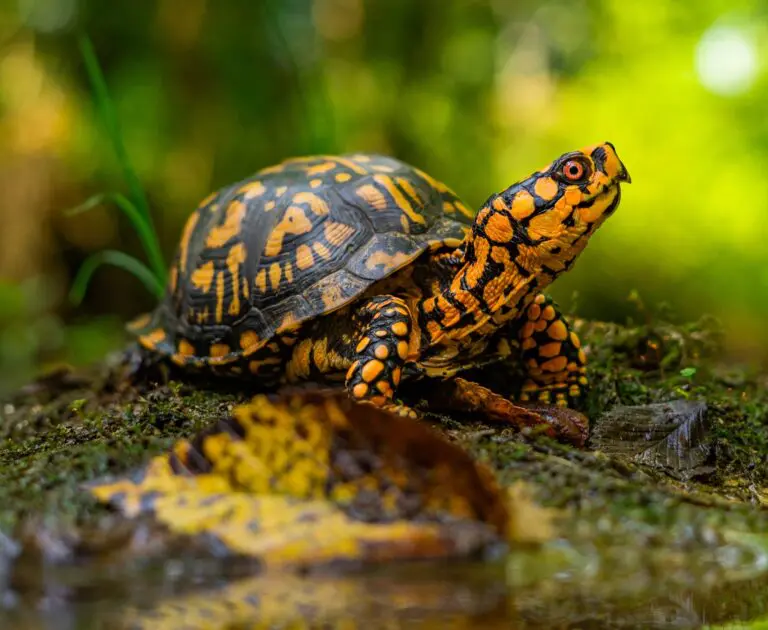
People understand why roads are dangerous for turtles. Cars and trucks are obvious threats. A turtle crossing a road is slow, exposed, and vulnerable. Railroads are different. Most people do not think of railroad tracks as a danger to animals. But for a box turtle, two steel rails can become walls.
In my previous post, I wrote about why relocating eastern box turtles can do more harm than good. Joy Hester followed relocated and resident box turtles in Davidson, North Carolina. The relocated turtles moved farther, used larger areas, and often died or disappeared. One of those turtles became trapped between railroad tracks and died.
That detail stuck with us. The turtle had not been hit by a train. It had not been run over by a car. It had become trapped in a narrow corridor created by infrastructure. The rails were not meant to be barriers, but to a turtle on the ground, that is exactly what they became.
That observation helped spur a follow-up study led by my student Yuri Kornilev (with Steve Price and me) on how eastern box turtles respond when trapped between railroad tracks. The problem is easy to miss unless you think like a turtle. A box turtle can enter the space between rails at a road crossing, gap, or low spot. Once inside, the turtle often moves along the track bed within the rails but is unable to climb over the rails to escape.
For a person, a railroad track is just something to step over. For a turtle, it can be a long, hot, exposed channel with steel barriers on both sides that can end in death. That changes the way we think about infrastructure. Roads kill wildlife directly when vehicles strike animals. But infrastructure does not always have to kill by impact. It can also fragment habitat, redirect movement, or create traps where the risk of death increases.
Other studies have reached similar conclusions for turtles and tortoises. Researchers studying gopher tortoises found that railways can alter movement and behavior, acting as barriers in the landscape. Studies of Hermann’s tortoises in Europe have also identified railroad-associated mortality hotspots. The species and landscapes differ, but the pattern is familiar: railroads can affect turtles not only by direct strikes, but by changing where they can move and whether they can escape.
For turtles, these problems are especially important because they are long-lived animals. Adult survival matters. Losing even a few adults from a local population can have consequences that are not immediately obvious. A railroad track may seem like a thin line on the landscape. To a turtle, it can be a giant wall that cannot be scaled — or even worse, a deadly trap.
The broader lesson is the same one that came from the relocation study: turtles experience landscapes at turtle scale. A place that looks passable to us may be difficult or dangerous for them. A short distance to us may be a major movement challenge. A harmless-looking structure may change where they can go and whether they survive.
Conservation often requires seeing familiar places differently. Not just as roads, railroads, fields, ditches, fences, and neighborhoods. But as animals experience them. For a box turtle, the danger may not be obvious from above. Sometimes it is only visible from a few inches off the ground.
References:
Hester, J. M., S. J. Price, and M. E. Dorcas. 2008. Effects of relocation on movements and home ranges of eastern box turtles. Journal of Wildlife Management 72:772–777.
Kornilev, Y. V., S. J. Price, and M. E. Dorcas. 2006. Between a rock and a hard place: Responses of eastern box turtles, Terrapene carolina, when trapped between railroad tracks. Herpetological Review 37:145–148.
Rautsaw et al. 2018. Stopped dead in their tracks: The impact of railways on gopher tortoise movement and behavior. Copeia 106:135–143.
Iosif, R. 2012. Railroad-associated mortality hot spots for a population of Romanian Hermann’s tortoise. Procedia Environmental Sciences 14:123–131.