
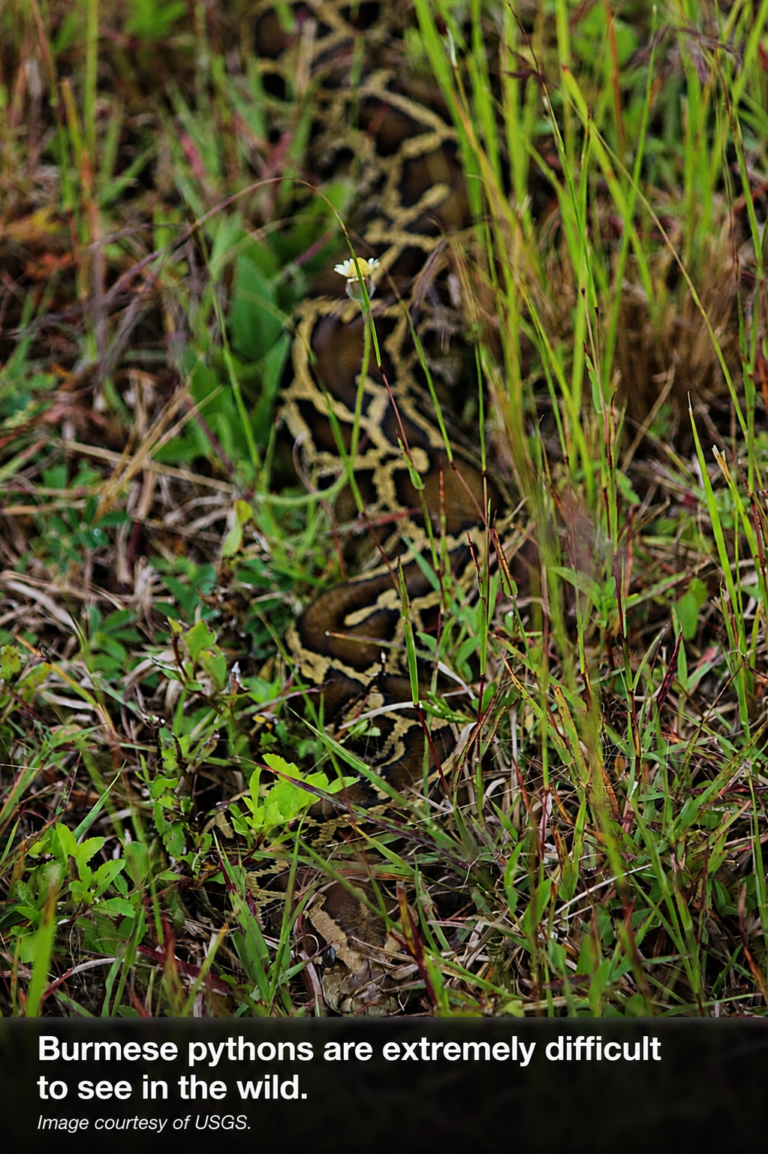
A Burmese python can be enormous and still be extraordinarily difficult to find.
Its patterned body blends into vegetation. It may remain inactive, submerged, underground, or concealed under cover. Much of the Greater Everglades is remote, flooded, and difficult to search. Even an experienced observer can miss a large snake at close range.
That makes detection one of the central problems in python research and management.
How difficult are they to detect?
Nafus, Mazzotti, and Reed (2020) combined visual surveys with radiotelemetry and estimated detection probabilities ranging from 0.0001 to 0.0146, depending on the analytical method and how search effort was measured.
Those are estimates for particular survey conditions, not a universal probability for every search. But they illustrate why failing to see a python provides little evidence that none is present.
Finding more does not necessarily mean there are more
Search results depend on effort, access, weather, season, snake activity, and observer experience. More removals could reflect a growing population, but they could also reflect more searching or better detection. Fewer removals could likewise result from reduced effort or less-visible snakes.
Removal records are valuable. They are not, by themselves, a population census.
Improving detection
Scout snakes, detector dogs, and environmental DNA can provide additional ways to locate pythons or evidence of their presence. Their usefulness depends on the setting and the question being asked. A positive DNA sample, for example, does not establish how many snakes are present or whether they are reproducing.
Better detection can help identify occupied areas, guide removals, and evaluate management. It does not remove the need to account for animals that remain unseen.
A python that is difficult to find can still have a substantial ecological effect. Understanding what our searches miss is therefore just as important as counting what they find.
References
Nafus, M. G., Mazzotti, F. J., & Reed, R. N. 2020. Estimating detection probability for Burmese pythons with few detections and zero recapture events. Journal of Herpetology 54:24–30. https://doi.org/10.1670/18-154
Guzy, J. C., et al. 2023. Burmese pythons in Florida: A synthesis of biology, impacts, and management tools. NeoBiota 80:1–119. https://doi.org/10.3897/neobiota.80.90439
This Insight is part of my ongoing LinkedIn series on reptiles, amphibians, conservation biology, invasive species, and scientific writing. Follow Michael E. Dorcas on LinkedIn for new posts and discussion.