
Evolution After Arrival — Part 3
In the previous part of this series, I asked whether the severe January 2010 freeze might have done more than kill Burmese pythons in South Florida. By disproportionately eliminating some snakes while others survived, could the freeze have changed the genetic composition of the population?
A genomic study published in 2018 attempted to answer that question. Its conclusion was both compelling and appropriately complicated:
Florida’s Burmese python population evolved over a remarkably short period, and natural selection appears to have contributed—but the study could not show that the freeze acted alone.
What did the researchers compare?
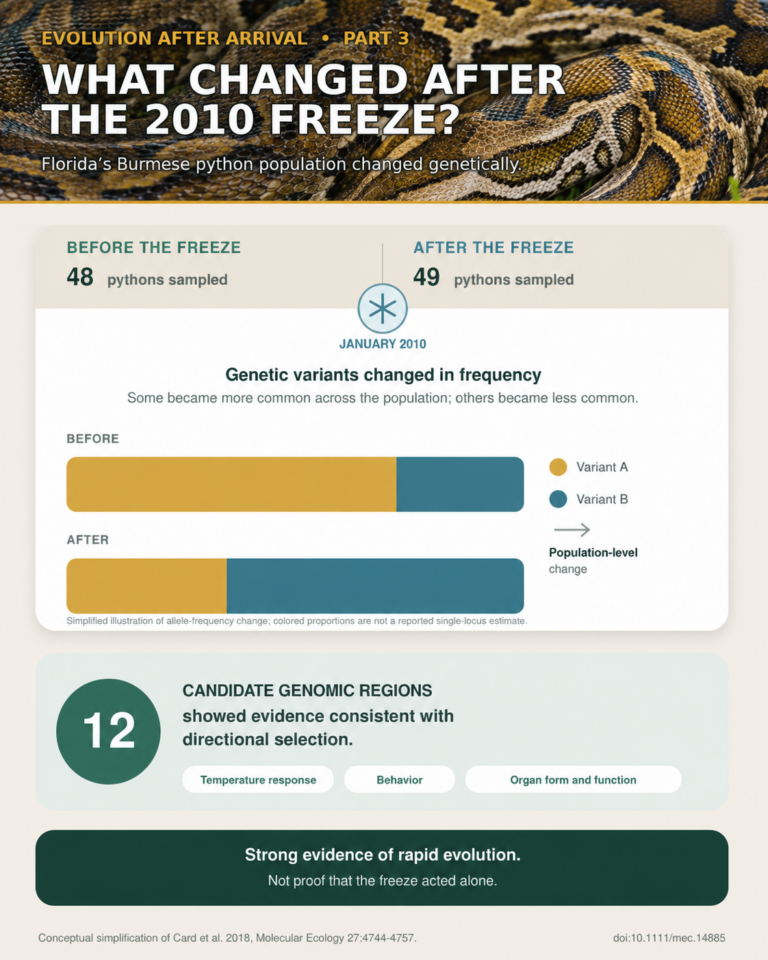
Daren Card and colleagues analyzed DNA from 97 Burmese pythons collected in South Florida during two periods separated by the freeze. The first group included 48 snakes collected between May 2003 and June 2009. The second included 49 collected between October 2012 and December 2013.
The researchers examined 1,021 genetic variants distributed across more than 23,000 sampled regions of the nuclear genome.
To understand what they were looking for, it helps to distinguish changes in individuals from changes in populations. The freeze did not alter the DNA of the snakes that survived. Instead, the researchers asked whether particular genetic variants became more or less common in the population after the freeze.
An allele is simply one version of a genetic sequence. If the frequency of an allele changes from one generation to the next, the population has evolved. That does not necessarily mean the change was beneficial or caused by natural selection. Allele frequencies can also fluctuate through genetic drift—the effects of chance, especially in a relatively small population.
The important question was therefore not simply whether allele frequencies changed. It was whether some changes were too large or too consistent to be explained by chance alone.
The population changed—and drift was not enough to explain it
The frequencies of many variants differed between the pre-freeze and post-freeze samples. Simulations showed that the largest changes were unlikely to have resulted from neutral genetic drift alone. The researchers also compared the real pre- and post-freeze groupings with randomly assigned groups and found that the temporal pattern was not what would be expected from random sampling.
They then used two independent analytical approaches to search the genome for unusually strong changes. One looked for genetic variants that were extreme outliers based on several measures of population differentiation. The other estimated the strength of selection while accounting for population history and demographic change.
Together, the two approaches identified 12 candidate genomic regions with evidence consistent with directional selection.
This distinction is important. The study did not identify 12 “cold-tolerance genes.” It identified 12 regions of the genome in which patterns of genetic change suggested that natural selection had occurred. Those regions contained 78 annotated genes associated with a variety of biological functions.
Among the most prominent categories were temperature sensing, responses to hypothermia, learning and behavior, stress responses, reproduction, immunity, and organ growth and function.
The connections to temperature and behavior made biological sense. As the earlier parts of this series showed, surviving severe cold depends partly on an animal’s physiological tolerance and partly on what it does—whether it finds an effective refuge, enters it early enough, and remains there while temperatures are dangerous.
The most unexpected genomic signal, however, involved something that might initially seem unrelated to cold:
Digestion.
A python’s digestive system is unusually dynamic
Burmese pythons evolved in seasonal environments in Southeast Asia where prey availability can vary dramatically. They may consume a very large meal and then go for an extended period without eating.
Their digestive physiology reflects that feast-or-famine existence. During a long fast, a Burmese python substantially downregulates its digestive system and metabolism, conserving energy when there is nothing to digest. After feeding, the process reverses with remarkable speed.
Within approximately 48 hours, organs including the heart, liver, kidneys, and small intestine can increase substantially in mass. Metabolic rate can increase as much as 40-fold. Once digestion is complete, those systems are downregulated again.
South Florida presents a different ecological setting. Potential prey are available throughout much of the year, giving pythons more opportunities to feed consistently. Necropsy data examined in the study supported that contrast: among 455 Florida pythons collected from 2003 through 2008, approximately 94% contained a food item, with relatively little difference between wet and dry seasons.
Directly comparable data were not available from native Burmese python populations, so that figure should not be treated as a precise native-versus-Florida comparison. Nevertheless, it supported the broader conclusion that Florida pythons were feeding frequently throughout the year rather than following a strongly seasonal feast-or-famine pattern.
Several of the genomic regions showing evidence of selection contained genes involved in cell division, organ growth, calcium signaling, and the regulation of the dramatic physiological changes that follow feeding.
That led to an intriguing hypothesis: perhaps Florida pythons were evolving toward a more consistently active digestive and metabolic state.
What did the physiological evidence show?
To investigate that possibility, the researchers compared seven fasted Florida pythons collected in 2016 with laboratory pythons in controlled fasted and post-feeding conditions. They examined patterns of gene expression and the microscopic structure of cells in several organs.
The fasted Florida snakes were not physiologically identical to the fasted laboratory snakes. In several respects, their patterns of gene expression appeared intermediate between the laboratory snakes’ fasted and fed states. Cells from several organs in the fasted Florida pythons also more closely resembled those of actively digesting laboratory pythons than those of laboratory pythons that had been fasting.
Several genes associated with post-feeding organ growth—and located within genomic regions showing evidence of selection—were also expressed differently in the Florida snakes.
Together, these findings were consistent with a more upregulated physiological state: even when fasting, the Florida pythons may not have downregulated their organs and metabolism as extensively as laboratory pythons did.
But this part of the study had important limitations. The Florida and laboratory snakes were not raised under identical conditions, and the researchers could not conduct a fully controlled common-garden experiment. Differences in gene expression and organ structure could therefore reflect physiological plasticity—the ability of an individual animal to adjust to its environment—rather than inherited genetic adaptation. They could also result from a combination of plasticity and evolution.
The gene-expression and histological evidence supported the evolutionary interpretation, but it did not prove it.
What does digestion have to do with surviving cold?
Burmese pythons are ectotherms, so their body temperatures are strongly influenced by their surroundings. Nevertheless, metabolism produces heat. A python with more active organs and a higher metabolic rate may be able to maintain a somewhat higher body temperature than a snake in a deeply downregulated fasting state.
The researchers therefore proposed that two different selective pressures may have acted in the same general direction.
Consistent access to prey may have favored pythons capable of keeping their digestive systems ready for more frequent feeding. Periodic severe cold may also have favored a more active metabolic state if it helped some snakes remain warmer or function better at low temperatures.
Under that hypothesis, feeding ecology and cold tolerance would not represent two separate stories. They could be interacting parts of the same evolutionary response to South Florida.
It is an intriguing explanation—but it remains a hypothesis. The study did not experimentally demonstrate that post-freeze pythons tolerate lower temperatures than pre-freeze pythons, nor did it directly establish that maintaining more active digestive organs improved survival during the 2010 freeze.
So, did the freeze cause Florida’s pythons to evolve?
The evidence supports a carefully divided answer.
Florida’s Burmese python population changed genetically between the two sampling periods. The largest allele-frequency shifts were unlikely to have resulted from genetic drift alone, and multiple analyses found evidence of directional selection. In that sense, the study provided strong evidence that rapid evolution occurred.
But the samples were not collected immediately before and after the freeze. They spanned two broader periods—2003–2009 and 2012–2013—during which pythons were responding to many aspects of their new environment. The researchers therefore could not determine how much of the observed change resulted from the freeze, how much resulted from longer-term pressures such as year-round prey availability, or whether the two acted together.
Nor did the study demonstrate that every post-freeze python was genetically more cold-tolerant. Evolution changes the frequencies of inherited variants across a population; it does not transform every surviving individual in the same way.
The safest conclusion is also the most interesting:
Florida’s Burmese pythons are not static copies of the snakes introduced decades ago. They are an evolving population responding to a new ecological and climatic environment.
That matters for invasive-species management. Predictions about where an introduced species can survive or how it will behave are often based on characteristics observed in its native range or during the early stages of invasion. But those characteristics can change.
A severe event such as the 2010 freeze may kill many animals and temporarily suppress population growth. If the population survives, however, the event may also act as a selective filter. The next generation will be produced by the survivors—not by a random sample of the population that existed before the event.
The freeze did not benefit the pythons it killed. But it may have helped shape a population better suited to the environment it now occupies.
That is evolution after arrival.
References
Card, D. C., Perry, B. W., Adams, R. H., et al. 2018. Novel ecological and climatic conditions drive rapid adaptation in invasive Florida Burmese pythons. Molecular Ecology.
https://doi.org/10.1111/mec.14885
Mazzotti, F. J., Cherkiss, M. S., Hart, K. M., et al. 2011. Cold-induced mortality of invasive Burmese pythons in south Florida. Biological Invasions 13:143–151.
https://doi.org/10.1007/s10530-010-9797-5
Secor, S. M. 2008. Digestive physiology of the Burmese python: broad regulation of integrated performance. Journal of Experimental Biology 211:3767–3774.
https://doi.org/10.1242/jeb.023754
Dorcas, M. E., Willson, J. D., Reed, R. N., et al. 2012. Severe mammal declines coincide with proliferation of invasive Burmese pythons in Everglades National Park. Proceedings of the National Academy of Sciences 109:2418–2422.
https://doi.org/10.1073/pnas.1115226109