
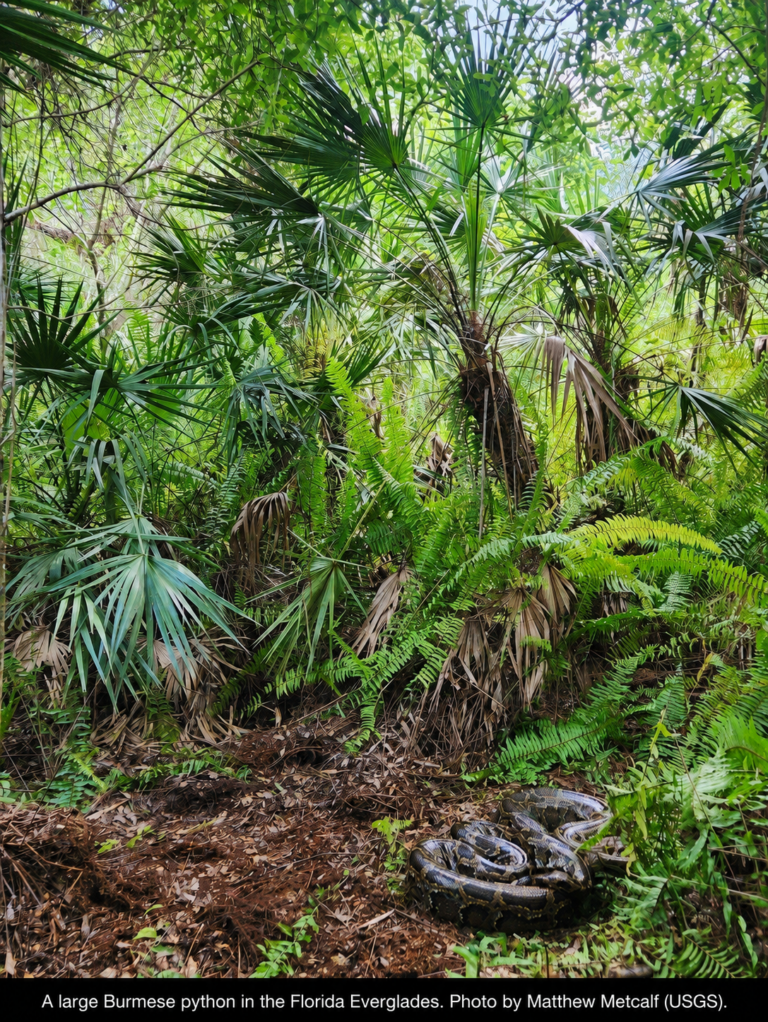
In January 2010, an unusually severe freeze killed many Burmese pythons in South Florida.
But could the same event ultimately have left the surviving population better able to withstand future cold?
That may sound contradictory. Yet an extreme event can act in two directions at once: it can reduce a population immediately while also changing which inherited traits are carried forward by the survivors.
In early January 2010, while the last of our experimental Burmese pythons were attempting to survive an unusually severe winter in South Carolina (see previous post), the same mass of arctic air swept through Florida.
From January 2 through 11, South Florida experienced one of its most severe cold spells on record. Air temperatures remained at or below 10°C (50°F) for at least 48 hours. On January 11, monitoring stations across the region recorded temperatures ranging from −4 to 0°C (25–32°F), and ice formed on shallow water near Everglades National Park.
The biological consequences were dramatic—and they extended far beyond Burmese pythons.
Researchers later documented 151 dead American crocodiles and 36 dead Burmese pythons associated with the cold spell. No dead American alligators or native snakes were found during the same surveys.
More than 4,500 sea turtles were cold-stunned across Florida. Many were rescued, treated, and released, but 434 green turtles died at St. Joseph Bay alone.
During the broader cold-related manatee mortality event of winter 2009–2010, 480 dead manatees were verified statewide. At least 252 of those deaths were attributed to cold exposure.
Invasive green iguanas became immobilized and fell from trees throughout South Florida. Some recovered when temperatures rose; others died. Because no reliable population estimate existed, however, the number and proportion killed could not be determined.
This was not simply an invasive-species die-off. Native and nonnative animals were affected—but not equally.
What happened to the pythons?
Frank Mazzotti and colleagues—including me—were already tracking ten free-ranging Burmese pythons in the Everglades when the freeze arrived. Each carried a surgically implanted radio transmitter and temperature datalogger.
Nine of the ten died during the freeze.
All ten radio-tracked pythons were found on the ground surface or in vegetation rather than inside protected underground refugia. Several apparently continued trying to bask as temperatures became dangerously low. Their body temperatures rose and fell daily before the coldest period, then dropped sharply between January 9 and 11.
The lone survivor was found in a hardwood hammock with dense vegetation and leaf litter—a setting that may have provided a drier and better-insulated refuge than the wetter habitats occupied by most of the snakes that died.
At first glance, losing nine of ten tracked pythons might suggest that the freeze nearly eliminated the population. But the broader observations told a more complicated story.
Researchers found 104 additional, untracked pythons during and shortly after the cold spell. Among the 99 for which fate was recorded, 59 were alive and 40 were dead. Thirteen of the dead snakes had been killed by vehicles, mowing, people, or other causes that could not be attributed directly to the freeze.
In fact, many of the dead pythons were discovered because vultures found them first. When researchers saw vultures gathering in an area, they investigated and sometimes found a python carcass. A living python concealed in the same landscape would be far less likely to attract attention.
These snakes were not a random sample, so the numbers cannot be used to calculate a population-wide survival rate. Dead snakes may have been easier to detect—sometimes because vultures drew attention to them—while surviving pythons remained hidden. Nevertheless, the observations established something important:
Many pythons survived.
Most survivors were associated with elevated or human-modified habitats such as roads, levees, and canals, where dry burrows, erosion holes, and other refugia were more available. All six pythons found in higher areas northwest of Everglades National Park were alive.
Paradoxically, the waterlogged Everglades may sometimes offer less protection from extreme cold than somewhat drier areas farther north.
Sometimes behavior matters as much as physiology
The contrast between American crocodiles and American alligators makes this point especially clear.
Both species bask during cool weather. But when temperatures become dangerously cold, alligators stop basking and retreat into thermally buffered water. In colder parts of their range, they may remain almost completely submerged with only their nostrils exposed—even when ice forms around the snout.
Their bodies remain in liquid water, which is usually warmer and far more stable than the surrounding air.
American crocodiles apparently responded differently during the 2010 freeze. Many continued attempting to bask, exposing themselves to cold air, wind, and substrate until their body temperatures became lethal. Researchers documented 151 dead crocodiles but no dead alligators.
The pythons that died appeared to behave more like the crocodiles.
A separate study in Gainesville produced a similar result. Seven of nine captive Burmese pythons died—or would have died without intervention—even though heated refugia were available. The two snakes that remained in the heated refugia survived.
Our South Carolina experiment showed the same general pattern. The pythons that used underground refugia consistently survived longer than those that remained exposed, used the pond, or emerged to bask during freezing weather.
These studies do not mean that physiology is unimportant. A snake eventually dies if its body temperature remains below its physiological limits, regardless of its behavior.
But behavior helps determine whether the animal ever experiences those temperatures.
Natural selection can therefore favor not only animals whose bodies tolerate cold, but animals whose behavior keeps their bodies from becoming lethally cold.
Did the freeze cause evolution?
It may have—but the mortality study alone could not demonstrate it.
For natural selection to produce evolutionary change, three things are required:
- Individuals must differ in some trait.
- Those differences must affect survival or reproduction.
- At least some of the variation must be inherited.
The 2010 freeze clearly produced unequal survival. Some pythons died, while others survived. Refuge availability and behavior appeared to contribute to those differences.
What the studies did not establish was whether the survivors possessed inherited differences in cold tolerance or refuge-seeking behavior. Some may simply have occupied better habitat. Others may have survived partly through chance.
Behavior can also change without evolution. An individual animal may learn, acclimate, or respond differently after experiencing cold. But if tendencies such as entering refugia early and remaining there are partly inherited, even a single severe freeze could change the population by disproportionately eliminating snakes with less effective responses.
If the survivors reproduce and those inherited differences become more common, evolution has occurred—even if the event happens only once.
Additional freezes could reinforce—or possibly reverse—that change, but evolution does not require the event to be repeated. Strong natural selection during a single extreme-weather event has also been documented in other animals, including cliff swallows.
The freeze killed many pythons and probably reduced population growth temporarily. It did not eradicate the established population. Instead, it left survivors—and those survivors produced future generations.
So, did the 2010 freeze actually benefit Florida’s invasive pythons?
It certainly did not benefit the individuals it killed. At the population level, however, it may have left behind snakes with behaviors, physiological traits, or other characteristics that made them more likely to survive severe cold.
If some of those differences were inherited, a disastrous event for individual pythons may ultimately have produced a population better prepared for the next freeze.
Did that actually happen?
Answering that question required samples collected before and after the freeze—and a genomic study published several years later attempted to find the answer.
That will be Part 3 of Evolution After Arrival.
References:
Mazzotti, F. J., M. S. Cherkiss, K. M. Hart, R. W. Snow, M. R. Rochford, M. E. Dorcas, and R. N. Reed. 2011. Cold-induced mortality of invasive Burmese pythons in south Florida. Biological Invasions 13:143–151.
https://doi.org/10.1007/s10530-010-9797-5
Dorcas, M. E., J. D. Willson, and J. W. Gibbons. 2011. Can invasive Burmese pythons inhabit temperate regions of the southeastern United States? Biological Invasions 13:793–802.
https://doi.org/10.1007/s10530-010-9869-6
Avery, M. L., R. M. Engeman, K. L. Keacher, et al. 2010. Cold weather and the potential range of invasive Burmese pythons. Biological Invasions 12:3649–3652.
https://doi.org/10.1007/s10530-010-9761-4
Mazzotti, F. J., M. S. Cherkiss, M. Parry, et al. 2016. Large reptiles and cold temperatures: Do extreme cold spells set distributional limits for tropical reptiles in Florida? Ecosphere 7.
https://doi.org/10.1002/ecs2.1439
Brandt, L. A., and F. J. Mazzotti. 1990. The behavior of juvenile Alligator mississippiensis and Caiman crocodilus exposed to low temperature. Copeia 1990:867–871.
https://doi.org/10.2307/1446456
Hardy, S. K., C. J. Deutsch, T. A. Cross, M. de Wit, and J. A. Hostetler. 2019. Cold-related Florida manatee mortality in relation to air and water temperatures. PLOS ONE 14.
https://doi.org/10.1371/journal.pone.0225048
Avens, L., L. R. Goshe, C. A. Harms, et al. 2012. Population characteristics, age structure, and growth dynamics of neritic juvenile green turtles in the northeastern Gulf of Mexico. Marine Ecology Progress Series 458:213–229.
https://doi.org/10.3354/meps09720
Brown, C. R., and M. B. Brown. 1998. Intense natural selection on body size and wing and tail asymmetry in cliff swallows during severe weather. Evolution 52:1461–1475.
https://doi.org/10.1111/j.1558-5646.1998.tb02027.x
#BurmesePython #InvasiveSpecies #NaturalSelection #EvolutionAfterArrival #ConservationBiology