
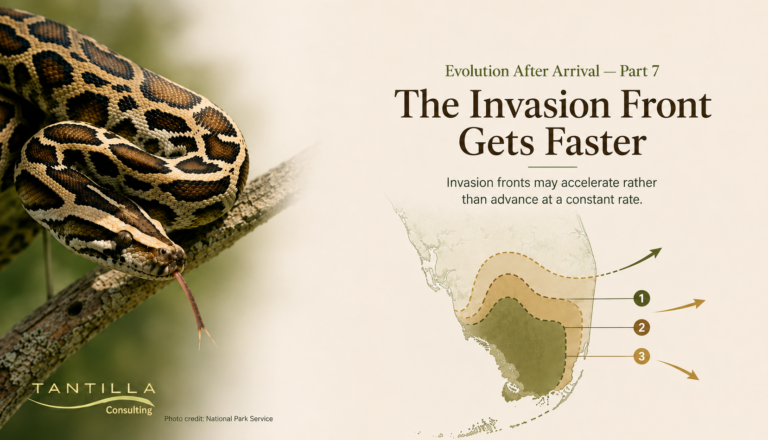
Throughout this series, I have discussed predictions about how far Burmese pythons (Python bivittatus) might eventually spread beyond their current range in South Florida. Climate models, cold tolerance, evolutionary change, and other factors may all affect where that range might ultimately extend.
But I am often asked another question: How long would it take them to get there?
That turns out to be a much harder question to answer. It is tempting to look at how quickly Burmese pythons have spread in the past, calculate a rate of range expansion, and project that rate into the future. If the invasion front has been moving a certain number of kilometers per year, perhaps we can simply extend the line.
The problem is that invasion fronts do not necessarily move at a constant speed. Sometimes they accelerate, and they can do so for more than one reason.
The animals at the front may be different
Consider an expanding population in which some individuals naturally move farther than others. The animals most likely to reach the leading edge will disproportionately be those that disperse farther. Once there, they are also more likely to encounter and reproduce with other individuals that have successfully reached the front.
This process is known as spatial sorting. Individuals are effectively being sorted across the landscape according to their dispersal characteristics. If some of those characteristics are heritable, spatial sorting can interact with natural selection. Over generations, populations near the invasion front can become increasingly dominated by individuals predisposed to move farther or faster.
That creates the possibility of a feedback loop: good dispersers reach the front, reproduce there, and produce descendants that are themselves good dispersers. One of the best-known examples comes from an animal very different from a python: Australia’s cane toads.
An invasion that became much faster
Cane toads (Rhinella marina) were introduced into northeastern Australia in 1935. Early in the invasion, their range was expanding at roughly 10–15 kilometers per year. Decades later, the invasion front in northern Australia was advancing at approximately 55–60 kilometers per year—roughly five times faster.
Researchers also found biological differences in the animals at the leading edge. Invasion-front toads had characteristics associated with greater movement—relatively longer legs, for example—and subsequent experiments provided evidence that differences in dispersal had a heritable component. In other words, the rate of spread was not simply a fixed property of the species; the invasion itself changed as it unfolded.
That does not mean that every invasion will evolve faster dispersal, or that every accelerating invasion is driven by evolution. Ecological conditions can change the speed of an invasion as well. A recent snake invasion provides a particularly useful example.
A snake invasion that accelerated
Horseshoe whip snakes (Hemorrhois hippocrepis) were accidentally introduced to Ibiza, an island off the east coast of Spain. The snakes were likely introduced through the transport of ornamental olive trees from the Iberian Peninsula. Ibiza historically lacked native terrestrial snakes, and the endemic Ibiza wall lizard (Podarcis pityusensis) therefore evolved without this kind of predator.
The snakes have spread extensively across the island, and lizards have disappeared from areas following invasion. In a 2026 study in Proceedings of the Royal Society B, Guillem Casbas and colleagues reconstructed approximately two decades of the invasion and found that range expansion accelerated through time despite increasingly intensive efforts to remove snakes.
The ecological consequences also changed as the invasion progressed. In areas invaded relatively early, lizard populations could persist for more than a decade after snakes arrived. At more recently invaded locations, the interval between snake arrival and local lizard extirpation had declined to only a few years.
But the explanation proposed for this acceleration did not require the snakes themselves to have evolved faster dispersal. Instead, predator and prey densities can interact to create a moving wave. When snakes enter an area where prey are abundant, their populations can increase. Predation then reduces prey populations behind the expanding front, while snakes continue moving into areas ahead of the front where prey remain abundant.
The invasion can therefore accelerate through ecological dynamics alone. That distinction is important because faster spread does not automatically mean evolution.
Evolutionary potential may also be easy to underestimate
Another 2026 study involving an invasive snake adds an intriguing genetic dimension to the story. Brown treesnakes (Boiga irregularis) were accidentally introduced to Guam after World War II and subsequently became one of the most damaging vertebrate invaders ever documented. The founding population experienced an extreme genetic bottleneck, and genetic studies have shown extensive homozygosity and inbreeding.
At first glance, such a population might seem to have relatively little genetic variation available for future evolutionary change. Christopher Osborne and colleagues examined the Guam population using long-read genome sequencing, which can detect large structural changes in DNA that traditional approaches may miss.
They found nearly 19,000 structural genomic variants, including deletions, duplications, inversions, and other rearrangements. Structural variation affected considerably more of the genome than conventional single-nucleotide variation, including regions associated with functions such as immunity and olfaction.
The study does not show that these variants caused the Guam invasion to succeed, nor does it demonstrate that particular traits evolved after the snakes arrived. But it does provide an important warning against assuming that an invasive population that has passed through a severe founder bottleneck necessarily has little evolutionary potential remaining.
So how quickly could Burmese pythons spread?
That brings us back to the question I am often asked. If climate and physiological models suggest that Burmese pythons might eventually survive farther north or elsewhere beyond their current South Florida range, how long would it take them to get there?
The most accurate answer is that we do not know, and simply extrapolating from their past rate of spread may not provide the answer.
There is currently no evidence demonstrating that Burmese pythons in Florida are evolving to disperse farther or faster. I want to emphasize that point. The cane-toad and Ibiza studies do not demonstrate that the same processes are occurring in Florida pythons. What they demonstrate is that rates of invasion are biologically dynamic.
Population density changes. Prey availability changes. Animals encounter new habitats and environmental conditions. Individuals with different dispersal tendencies can become concentrated at an invasion front. Natural selection can occur, and previously overlooked genetic variation may provide material on which selection can act. Climate can change as well, potentially altering which environments are available to an expanding population.
Burmese pythons also present another problem that makes estimating spread particularly difficult: we are remarkably bad at finding them. As discussed in Part 6, even experienced searchers can pass many pythons without detecting them. That means the geographic boundary shown on a map is partly a boundary of detection, not necessarily the true edge of the population.
A newly colonized area could contain a small reproducing population for years before enough observations accumulate for us to recognize it. So even if the biological invasion front were moving at a constant rate—and there is no reason to assume that it must—we might not observe that movement in real time.
Where could they go—and when would they get there?
Those are really two different questions. Climate models and physiological studies can help us ask where Burmese pythons might ultimately be capable of surviving. Predicting when they might arrive is much more difficult.
To answer that, we would need to know not only where suitable environments occur, but how python populations behave at their expanding edge, how quickly populations grow after colonization, how landscape features affect movement, how climate changes through time, whether dispersal traits change, and how far the actual invasion front lies beyond the front we are able to detect.
That is a lot of biology hidden inside what sounds like a simple question. A range map can make an invasion look like a line moving across a landscape, but an invasion is not a line. It is a population of living organisms interacting with changing environments, prey, competitors, and one another.
For Burmese pythons, the evidence does not tell us that their invasion will accelerate. It tells us something more useful: we should not assume that its future speed will be the same as its past speed.
So when someone asks me how long it might take Burmese pythons to reach areas that models identify as potentially suitable, the answer is not a particular number of years. The answer is that the rate itself may change.
Past spread is evidence. It is not destiny.
References
Casbas, G., Vez-Garzón, M., Montes, E., Colomar, V., & Lapiedra, O. 2026. Real-time invasion dynamics reveal the drivers of predator spread and prey extirpation on an island. Proceedings of the Royal Society B: Biological Sciences 293: 20261344. DOI: 10.1098/rspb.2026.1344.
Osborne, C. A., Foote, B. M., Fleck, S. J., Waterman, H. M., Chang, S. L., Nafus, M. G., Bellinger, M. R., Gray, L. N., & Krabbenhoft, T. J. 2026. Genomic structural variation rescues a classic biological invader from a population bottleneck. Science Advances 12: eaed3656. DOI: 10.1126/sciadv.aed3656.
Phillips, B. L., Brown, G. P., Webb, J. K., & Shine, R. 2006. Invasion and the evolution of speed in toads. Nature 439: 803. DOI: 10.1038/439803a.
Phillips, B. L., Brown, G. P., & Shine, R. 2010. Evolutionarily accelerated invasions: the rate of dispersal evolves upwards during the range advance of cane toads. Journal of Evolutionary Biology 23: 2595–2601. DOI: 10.1111/j.1420-9101.2010.02118.x.
#BurmesePython #InvasiveSpecies #InvasionBiology #RangeExpansion #ConservationBiology #Evolution #TantillaInsights