
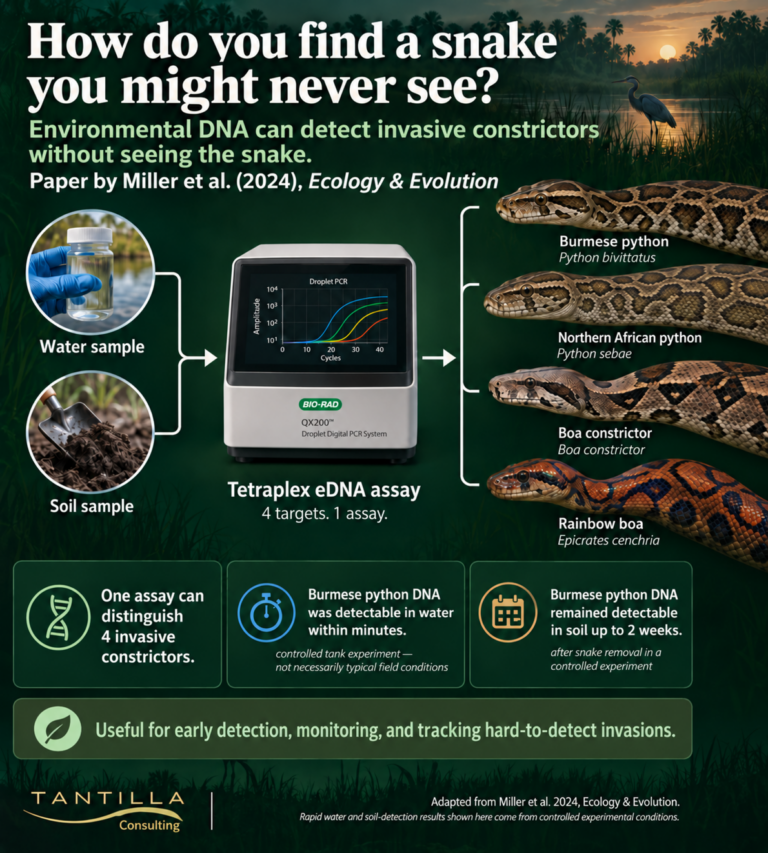
One of the biggest problems with invasive snakes is remarkably simple: they can be very difficult to find. John (J.D.) Willson and I wrote about this problem in our 2011 book, Invasive Pythons in the United States: Ecology of an Introduced Predator, and again in a 2013 book chapter we deliberately titled “Hidden Giants: Problems Associated with Studying Secretive Invasive Pythons.” The title captured a frustrating contradiction. Burmese pythons can become enormous animals, yet finding one in the Everglades can be extraordinarily difficult.
That difficulty is not just an inconvenience for researchers. It affects nearly everything we would like to know about an invasion: Where are the snakes? How quickly are they spreading? How many are present? Has a new population become established? Are control efforts reducing their numbers? Perhaps most importantly, can we find an invasion early enough to do something about it? More recent research has quantified just how difficult that problem can be. Nafus and colleagues analyzed visual surveys and radiotelemetry data for Burmese pythons in South Florida and estimated detection probabilities well below 5%. Depending on the analytical approach and how survey effort was measured, estimated probabilities were actually much lower than that in many cases.
Think about what that means: failure to see a python provides remarkably little evidence that no python is there.
That problem becomes especially important near an invasion front or following a new introduction. As I discussed previously in One Python Is Not a Population—Until It Is, finding one free-ranging snake does not demonstrate an established population. But the reverse is equally important: failing to find snakes does not demonstrate that a population is absent. A secretive species can potentially reproduce and become established before people recognize it is even present.
So what if, instead of looking for the snake, we looked for something the snake left behind?
Looking for DNA instead of snakes
That is the promise of environmental DNA, or eDNA. Animals continually leave biological material behind—skin cells, mucus, feces, urine, and other traces containing DNA. Instead of capturing or visually observing an animal, researchers can collect environmental samples such as water or soil and test those samples for species-specific genetic material. For something as cryptic as a Burmese python, that changes the detection problem considerably.
Earlier work by Margaret Hunter and colleagues demonstrated the potential of eDNA for Burmese python monitoring in South Florida. Their 2015 study estimated a cumulative laboratory detection probability of 91–100% when three qPCR replicates were used and python DNA was present in the sample. That is not the probability of detecting a nearby python from one bottle of water. Collecting DNA in the field remains a separate challenge, affected by where and when samples are taken, environmental conditions, and DNA distribution and degradation.
A 2024 study by Melissa Miller and colleagues in Ecology and Evolution takes that idea another step.
Four snakes, one assay
Miller and colleagues developed what is called a tetraplex digital PCR assay for invasive constrictors in Florida. The terminology sounds more complicated than the basic idea. “PCR”—polymerase chain reaction—is a method used to detect and amplify particular DNA sequences. Digital PCR, or dPCR, divides a sample into thousands of tiny reactions, allowing very small quantities of target DNA to be detected and quantified. “Multiplex” means looking for more than one target at the same time, and “tetraplex” means that this particular assay looks for four.
The assay developed by Miller and colleagues can distinguish DNA from four non-native constrictors with reproducing populations in South Florida: Burmese python (Python bivittatus), northern African python (Python sebae), boa constrictor (Boa constrictor), and rainbow boa (Epicrates cenchria). These are not four ecologically identical snakes. Burmese and northern African pythons are giant constrictors, and boa constrictors can also become very large. Rainbow boas are substantially smaller-bodied snakes and do not approach the size of the two pythons or, generally, large boa constrictors. What the four species share here is that they have all established populations outside their native ranges in South Florida, and their distributions overlap to varying degrees.
At the time Miller and colleagues were writing, they described evidence for rainbow boa establishment as probable, noting that multiple size classes and a gravid female had been found. Additional work published in 2024 by Jonathan Asher and Kenneth Krysko documented adults and neonates and concluded that rainbow boas are indeed established and reproducing in the Homestead/Turkey Point area.
Importantly, Miller and colleagues found no cross-amplification among the four target species. In other words, Burmese python DNA produced a Burmese python signal rather than being mistaken for the closely related northern African python, and the same species specificity applied to the other targets. That matters in South Florida, where multiple introduced constrictors occur and their distributions overlap. A sample does not simply tell a manager that “some large snake” may have been present. The assay is designed to identify which of these four target species contributed the DNA.
How little evidence can a snake leave behind?
The researchers also conducted controlled experiments to examine whether Burmese python DNA could be recovered from water and soil. In one experiment, a live Burmese python was placed in a container of water and samples were collected over several hours. Python DNA was detectable in samples collected just five minutes after the snake entered the water.
That is an impressive demonstration of assay sensitivity, but it needs context. A python confined in a relatively small container is very different from a python moving through the Everglades. DNA released into a tank is concentrated within a limited volume of water. In the field, DNA may be diluted, transported by moving water, degraded by sunlight or microorganisms, affected by temperature and chemistry, or missed entirely because researchers sampled the wrong water body or at the wrong time. So I would not interpret “five minutes” as a realistic field detection time. The important result is that the assay can detect relatively small amounts of biological material very rapidly under controlled conditions.
The soil experiment produced an equally interesting result for a different reason. Researchers sampled soil from an enclosure after a Burmese python had been removed, and python DNA was still detectable two weeks later. But there is an important wrinkle to the soil result: the researchers did not take random soil samples from around the enclosure. They sampled the specific location where the python had been observed resting before it was removed.
That distinction matters because eDNA behaves differently in terrestrial and aquatic environments. Water can move DNA away from the exact location where an animal shed it, potentially distributing the signal across a broader area. That can make aquatic eDNA detectable some distance from where the animal actually was, although it also complicates interpretation because the location of a positive water sample may not correspond precisely to the location of the animal. Soil does not provide that same kind of transport. DNA deposited at a resting site or travel path may remain relatively localized, so in a large terrestrial landscape researchers could miss a snake simply because they sampled soil away from where the animal actually left detectable material.
In practical terms, soil sampling may be most informative when it targets places snakes are especially likely to use—refuges, resting sites, travel corridors, basking sites, or other areas of repeated contact. Exactly how best to design terrestrial eDNA sampling for free-ranging constrictors remains an important field question. The soil experiment therefore illustrates both the sensitivity and the complexity of the technique: DNA can remain after the animal has left, but where that DNA can later be detected depends strongly on the environment through which it moves—or does not move.
Presence is not population size
Environmental DNA is sometimes described as though it solves the detection problem completely. It does not.
A positive eDNA sample can provide evidence that DNA from the target species is present in the sampled environment. Depending on the system and sampling circumstances, that can provide strong evidence that an animal is, or recently was, somewhere in the general area represented by the sample. But there are several questions that a positive sample cannot answer by itself. It does not tell us whether there was one snake or fifty. It does not tell us whether the animal was a recent escape or release. It does not tell us whether males and females are present, whether reproduction has occurred, or whether an established population exists.
That distinction is particularly important in invasion biology. For example, finding DNA from a northern African python in a new location would be important, and managers would have good reason to investigate further. But a positive sample would not allow us to conclude that northern African pythons had established a new reproducing population there.
The logic is the same one I have emphasized previously with physical snake records:
One snake is not a population. One positive DNA detection isn’t a population either.
Conversely, repeated detections across multiple locations and times could become increasingly informative, particularly when combined with captures, observations, genetics, reproductive evidence, and other data. The strength of eDNA is not that it answers every question. It is that it may tell us where to start looking.
An environmental “footprint”
The two-week persistence result also illustrates another interpretive challenge. Suppose a water or soil sample tests positive for python DNA. Does that mean a python is sitting there right now? Not necessarily. The animal may have moved. DNA can persist after its source is gone, and in aquatic systems it may also be transported away from the location where it was shed.
That means eDNA is better thought of as a kind of biological footprint than as a photograph. A footprint tells you an animal was there. It does not necessarily tell you when it passed, where it is now, or whether there were other animals with it. The analogy is imperfect because environmental DNA behaves differently depending on the substrate and environmental conditions. Water can disperse a DNA signal away from the organism that produced it, whereas terrestrial substrates such as soil may preserve a more localized signal that is easier to miss if sampling does not intersect somewhere the animal actually used.
Miller and colleagues explicitly recognize these uncertainties. Their controlled experiments were intended to demonstrate that the assay can detect target DNA and to begin evaluating its sensitivity. They note that field conditions—including distance from an animal, DNA persistence and degradation, environmental inhibitors, and sampling design—will have to be evaluated further. The new assay therefore should not be interpreted as a finished landscape-scale python census.
It is a detection tool.
Why detecting four species at once matters
The multiplex aspect of the study may ultimately be just as important as its sensitivity. South Florida is not dealing with a single introduced constrictor. All four species targeted by the assay now have reproducing populations there, although their distributions, abundance, ecological roles, and body sizes differ dramatically. Burmese pythons are by far the most widespread and extensively studied, occupying a large portion of the Greater Everglades. Northern African pythons have a much more localized South Florida population. Boa constrictors also have a localized established population, and rainbow boas are established around the Homestead/Turkey Point area.
Traditionally, testing environmental samples separately for each possible species takes additional time, reagents, and laboratory effort. A tetraplex assay allows all four targets to be evaluated simultaneously. That could become particularly useful for early detection and rapid response. Imagine that someone reports a large python in an area where the species identification is uncertain, or that managers want to survey wetlands along the suspected edge of an invasion. Instead of relying exclusively on someone eventually seeing or capturing a snake, environmental samples could provide another line of evidence.
Likewise, repeated sampling could potentially help managers identify places where a target species continues to be detected—or places where detections disappear following control efforts. Miller and colleagues also point toward an even broader possibility: multiplex assays could eventually be designed to monitor not only invasive species but native animals affected by them. That begins to turn eDNA from a species-detection technique into a broader ecological monitoring tool.
Detection changes what management is possible
Early detection is one of the oldest principles in invasive-species management for a simple reason. A few animals occupying a small area may sometimes be removable; a widespread reproducing population occupying thousands of square kilometers is a completely different problem. Burmese pythons in the Greater Everglades are now firmly in the second category. No current method allows managers simply to search the landscape and remove anything close to every python present, but every future invasion does not have to follow the same trajectory.
The real promise of eDNA may therefore be greatest when animals are still uncommon—precisely when traditional searches are least likely to find them. That creates an interesting paradox: the stage at which eradication may be most feasible is also the stage at which the invading animal is hardest to detect.
Better detection technology helps close that gap.
Finding evidence is only the beginning
There is a temptation with powerful new technology to ask it to answer more than it can. Environmental DNA does not eliminate the need for field biology. It does not replace trapping, telemetry, visual surveys, reproductive observations, population genetics, or careful natural-history work. And it does not turn a positive DNA signal into evidence of an established population.
What it can do is tell us something that has always been extraordinarily difficult with secretive invasive snakes:
DNA from the target species was detected in the sampled environment, providing a reason to investigate further.
For a species such as the Burmese python, whose ability to remain hidden has complicated research and management from the beginning of the invasion, that is no small advance. We have spent decades learning how difficult it is to find giant snakes in the Everglades. The next generation of monitoring may increasingly involve finding what they leave behind.
References
Dorcas, M. E., & Willson, J. D. 2011. Invasive Pythons in the United States: Ecology of an Introduced Predator. University of Georgia Press.
Dorcas, M. E., & Willson, J. D. 2013. Hidden giants: problems associated with studying secretive invasive pythons. In W. Lutterschmidt (ed.), Reptiles in Research: Investigations of Ecology, Physiology, and Behavior from Desert to Sea. Nova Science Publishers, Hauppauge, New York.
Hunter, M. E., Oyler-McCance, S. J., Dorazio, R. M., et al. 2015. Environmental DNA (eDNA) sampling improves occurrence and detection estimates of invasive Burmese pythons. PLoS ONE 10. https://doi.org/10.1371/journal.pone.0121655
Nafus, M. G., Mazzotti, F. J., & Reed, R. N. 2020. Estimating detection probability for Burmese pythons with few detections and zero recapture events. Journal of Herpetology 54:24–30. https://doi.org/10.1670/18-154
Miller, M. A., Bloch, M., Balaguera-Reina, S. A., et al. 2024. Development of a tetraplex digital PCR assay for the detection of invasive snake species in Florida, USA. Ecology and Evolution 14. https://doi.org/10.1002/ece3.70598
Asher, J. G., & Krysko, K. L. 2024. The Rainbow Boa, Epicrates cenchria (Linnaeus 1758) (Squamata: Boidae), another established non-native snake in Florida. Reptiles & Amphibians 31.