
When I was 13, I bought a baby reticulated python (Malayopython reticulatus) for a very simple reason: I loved snakes, and I wanted one that would get big.
It did.
About five years later, the snake was roughly 12 feet long. It was a very gentle snake, but feeding it had become a substantial undertaking, and cleaning up after it was no small matter either. Sometimes the turds were the size of volleyballs. Eventually I put an ad in the newspaper—this was long before the internet—and sold it.
I still remember the buyer. She was a very attractive young woman, and when my brother and I answered the door, we both had more or less the same reaction: wow! She was not afraid of the snake, although she seemed a little uneasy actually handling something that large. Still, she bought it – I think for $100.
As she was leaving, I asked why she wanted a 12-foot reticulated python.
“Oh, I’m a dancer,” she said.
At 18, I wasn’t quite sure what that meant. Looking back now, I’m pretty sure she was an exotic dancer planning to use the snake in her act.
What I do know is that I acquired that snake and later got rid of it for essentially the same reason: it got big.
That experience illustrates one of the problems associated with giant constrictors in the pet trade. A young python can be relatively easy to house and fascinating to keep. The same animal several years later may be 10, 12, or 15 feet long, enormously strong, expensive to feed, and much more difficult to manage safely.
Most owners who can no longer care for a very large snake find a responsible way to rehome it. But escape and intentional release are well-established pathways by which large constrictors have reached the wild. A major U.S. Geological Survey assessment of giant constrictors identified the pet trade as the principal pathway by which species such as pythons could become introduced and established in the United States.
Puerto Rico now gives us a reason to think about that pathway again.
As I discussed in my previous Insights article, reticulated pythons are no longer simply occasional escapees there. Multiple lines of evidence indicate an established, reproducing population.
That matters because this is not just another large snake.
It is the longest snake species in the world.
Length is only part of the story
Claims about record-sized snakes have always attracted exaggeration, and unusually large specimens should be measured carefully. But there is no question that reticulated pythons can reach extraordinary dimensions.
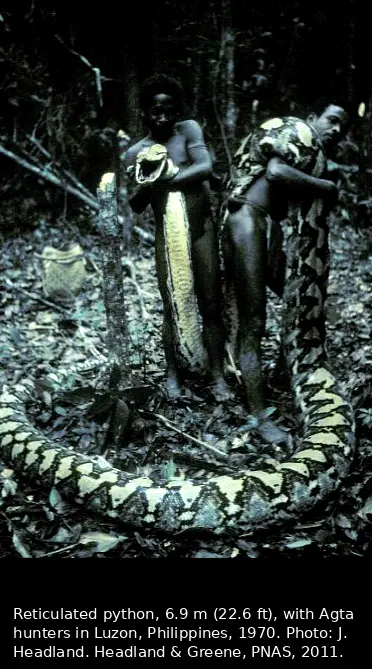
The snake in the photograph accompanying this article measured 6.9 m, or about 22.6 feet. At those lengths, a reticulated python is not merely long. It is a massive, extraordinarily muscular predator capable of subduing very large prey.
One published observation from Indonesian Borneo, for example, documented a reticulated python of approximately 7 m killing and swallowing an adult female Malayan sun bear. Green anacondas are generally more heavily built than retics, but very large reticulated pythons are formidable animals by any reasonable measure.
That brings us to one of the most interesting studies ever published about relationships between humans and snakes.
Humans and pythons as predator, prey, and competitors
In 2011, anthropologist Thomas Headland and herpetologist Harry Greene published a remarkable paper in the Proceedings of the National Academy of Sciences titled “Hunter–gatherers and other primates as prey, predators, and competitors of snakes.”
I have a personal connection to the photograph shown here. Before the paper was published, Harry sent me the image and made me promise not to circulate it until the article came out. I remember being struck then by exactly what makes the photograph so impressive now: the size of the python relative to the people standing beside it.
But the photograph was only one part of a much more interesting ecological story.
Headland had spent decades working with the Agta, hunter-gatherers in the Philippines. Headland and Greene drew on ethnographic information from 120 Agta who had lived a traditional foraging lifestyle and examined an ecological relationship that had received surprisingly little quantitative attention: what happens when people share a landscape with a snake large enough to prey on them?
Among the adult Agta men interviewed, 26% reported having survived predatory attacks by reticulated pythons. Headland and Greene also documented six fatal attacks between 1934 and 1973. Men were exposed disproportionately because they spent more time hunting alone in the forest.
Those numbers are striking, but focusing only on python attacks misses the most interesting point of the paper.
The Agta also hunted and ate reticulated pythons.
And humans and pythons hunted some of the same prey, including deer, wild pigs, and monkeys.
The ecological relationship therefore worked in three directions at once. Agta and reticulated pythons could be predators of one another, prey of one another, and competitors for food.
That is what makes the Headland and Greene paper so fascinating. It is not fundamentally a paper about “man-eating snakes.” It places humans back where we have spent most of our evolutionary history: inside a food web rather than standing apart from it, or only at the very top of it.
And the reticulated python is one of the relatively few living predators large enough that humans can occupy more than one position in that relationship.
Human predation is uncommon, but unquestionably real
It is important not to exaggerate the threat reticulated pythons pose to people.
Millions of people live within the species’ native range. Predatory attacks on humans are rare, and most encounters between people and reticulated pythons end without injury.
But human predation by this species is not folklore, nor is it merely something we infer might be possible because the snakes become large.
It is documented natural history.
In 2025, Muhammad Iqbal and colleagues reviewed documented and attempted predation events involving reticulated pythons and humans in Indonesia from 1927 through 2025. They identified 17 incidents, including 13 fatalities, involving snakes reported to be approximately 5–8 m long. Sulawesi accounted for a substantial proportion of the cases.
Those numbers should not be interpreted as an attack rate. The cases were compiled from documented incidents rather than from systematic surveillance, so there is no meaningful denominator telling us how frequently people actually encounter pythons.
The conclusion is narrower: large reticulated pythons are capable of treating humans as prey, and they have done so repeatedly.
Captivity presents a different kind of risk
Fatal incidents involving captive reticulated pythons are also well documented, although they are very rare.
One well-documented case occurred in Nevada in 1982 and was later described in the Journal of Forensic Sciences. A pet reticulated python escaped its enclosure and entered the room where a 21-month-old boy was sleeping. The forensic report attributed his death to asphyxia and documented puncture wounds consistent with the snake’s teeth.
Adult fatalities have occurred as well.
In Indiana in 2006, 23-year-old Patrick Von Allmen died after entering a backyard shed alone to treat a roughly 14-foot reticulated python. Contemporary reporting quoted an Indiana conservation officer who said the autopsy identified compression of the neck and chest as the cause of fatal asphyxiation. His family reported that he had handled reptiles for more than a decade.
In Virginia in 2008, 25-year-old Amanda Black died in an incident involving a captive reticulated python. Contemporary reports said she had apparently been attempting to administer medication. A subsequent USGS review included the incident among reported captive-python fatalities.
In Indiana in 2019, 36-year-old Laura Hurst was found unresponsive with an approximately 8-foot reticulated python around her neck, in a building housing about 140 snakes. Contemporary reporting of the coroner’s preliminary findings attributed her death to asphyxia from strangulation by the snake.
These events are notable partly because they do not all fit the simple image of a hungry snake mistaking its keeper for food. Several occurred while experienced people were treating or handling snakes.
The circumstances of individual deaths deserve careful attention. In its 2012 rulemaking, the U.S. Fish and Wildlife Service acknowledged reported fatalities involving captive large constrictors. However, a public comment attributing deaths to handling or feeding errors should not be treated as an agency determination of what caused each incident. The accounts above do not establish that the adult victims were mistaken for prey.
The broader lesson is simpler: once a reticulated python becomes large, a momentary mistake, unexpected response, or loss of control can have consequences very different from those associated with keeping a smaller snake.
The pet-trade paradox
That brings me back to my own snake.
The very characteristic that attracted me to a reticulated python as a 13-year-old—the prospect of owning a snake that would become exceptionally large—was eventually the reason I no longer wanted to keep it.
I doubt my experience was unique.
This does not mean that keeping reticulated pythons is inherently irresponsible. Many experienced keepers maintain large constrictors safely and responsibly for decades. But large adult size creates a practical problem that does not exist to the same degree with many other reptiles. Housing requirements increase. Feeding becomes more demanding. Handling becomes more difficult. Finding someone willing and qualified to take an unwanted adult becomes harder.
From an invasion perspective, the important point is that only a small fraction of animals need to escape or be released into appropriate habitat for introductions to occur.
Florida provides an instructive example.
Free-ranging reticulated pythons have been documented there repeatedly. In Invasive Pythons in the United States, the book John D. Willson and I wrote in 2011, we included a record of a reticulated python from Everglades National Park, and other individuals have been reported elsewhere in Florida.
There is currently no evidence that reticulated pythons have established a reproducing population in Florida. That distinction is important. One snake, or even several snakes scattered across different places and years, does not demonstrate establishment.
But it is equally important not to reverse the logic. Calling every free-ranging animal an escape or release does not prove that reproduction is absent.
Snakes are notoriously difficult to detect. A low-density population can be present for a considerable period before observations become frequent enough for people to recognize a pattern. The history of Burmese pythons in South Florida has made that lesson painfully clear.
Puerto Rico has now moved beyond that uncertainty with reticulated pythons.
What happens when the world’s longest snake becomes established?
Puerto Rico now has something Florida apparently does not: an established, reproducing population of reticulated pythons.
We still do not know how many are present, how far the population extends, how rapidly it is spreading, or what ecological effects it is already having. Those are exactly the questions that need attention now.
The potential ecological concern extends well beyond potential encounters with people. Reticulated pythons are generalist predators capable of consuming mammals, birds, and reptiles across an enormous range of body sizes. Young snakes consume relatively small prey; large adults can take very large animals. Establishment therefore introduces a novel predator capable of interacting with several levels of an existing food web.
That does not mean Puerto Rico will repeat the ecological history of Burmese pythons in the Everglades. The species are different, the ecosystems are different, and their invasion histories are different.
But South Florida provides a broader warning. Effects of a giant constrictor invasion may become obvious only after the population is large and widespread enough that controlling it has become extraordinarily difficult.
That is particularly relevant for an animal whose combination of cryptic behavior, broad diet, rapid growth, and extreme adult size makes it unlike almost any predator already present on Puerto Rico.
Human safety deserves to be part of that discussion because predation on humans is a demonstrated biological capability of very large reticulated pythons. But it should not dominate the discussion. The ecological question is much broader.
What happens when a secretive, generalist predator capable of exceeding 6 m in length begins reproducing in an ecosystem where it did not evolve?
Puerto Rico is now in a position to find out.
It would be far better to understand that invasion, and alter its trajectory if possible, before the answers become obvious.
References
Headland, T. N., & Greene, H. W. 2011. Hunter–gatherers and other primates as prey, predators, and competitors of snakes. Proceedings of the National Academy of Sciences 108–E1474. https://doi.org/10.1073/pnas.1115116108
Fredriksson, G. M. 2005. Predation on sun bears by reticulated python in East Kalimantan, Indonesian Borneo. Raffles Bulletin of Zoology 53:165–168.
Iqbal, M., Sari, D. K., Arifah, N., Widayanti, G. A., & Aprillia, I. 2025. Notes on humans as prey of reticulated pythons Malayopython reticulatus in Indonesia. Bio Palembanica 2:43–49. https://doi.org/10.36982/bio.v2i1.5385
McCarty, V. O., Cox, R. A., & Haglund, B. 1989. Death caused by a constricting snake—an infant death. Journal of Forensic Sciences 34:239–243. DOI: 10.1520/JFS12628J. https://pubmed.ncbi.nlm.nih.gov/2918282/
Reed, R. N., & Rodda, G. H. 2009. Giant Constrictors: Biological and Management Profiles and an Establishment Risk Assessment for Nine Large Species of Pythons, Anacondas, and the Boa Constrictor. U.S. Geological Survey Open-File Report 2009-1202. https://doi.org/10.3133/ofr20091202 Author-uploaded full text
U.S. Fish and Wildlife Service. 2012. Injurious Wildlife Species; Listing Three Python Species and One Anaconda Species as Injurious Reptiles. Federal Register 77:3330–3366. https://www.govinfo.gov/content/pkg/FR-2012-01-23/html/2012-1155.htm
Colston, T. J., et al. 2026. The complete genome sequences of 5 species of reptiles invasive in Puerto Rico. Biodiversity Genomes. https://doi.org/10.56179/001c.161013
Dorcas, M. E., & Willson, J. D. 2011. Invasive Pythons in the United States: Ecology of an Introduced Predator. University of Georgia Press.
14 News. 2006. Owner crushed by 14-foot pet python. https://www.14news.com/story/5365538/owner-crushed-by-14-foot-pet-python/
WBAA. 2019. Coroner’s report confirms death by snake strangulation. November 1, 2019. https://www.wbaa.org/general-news/2019-11-01/coroners-report-confirms-death-by-snake-strangulation
#ReticulatedPython #InvasiveSpecies #PuertoRico #InvasionBiology #SnakeEcology #ConservationBiology #TantillaInsights